


Campaign Encourages Palestinians to Boycott Israeli Goods in Ramadan and Afterwards
TEHRAN (IQNA) – "Do not let the occupation make your iftar", reads a poster from the latest boycott campaign launched across the occupied West Bank.
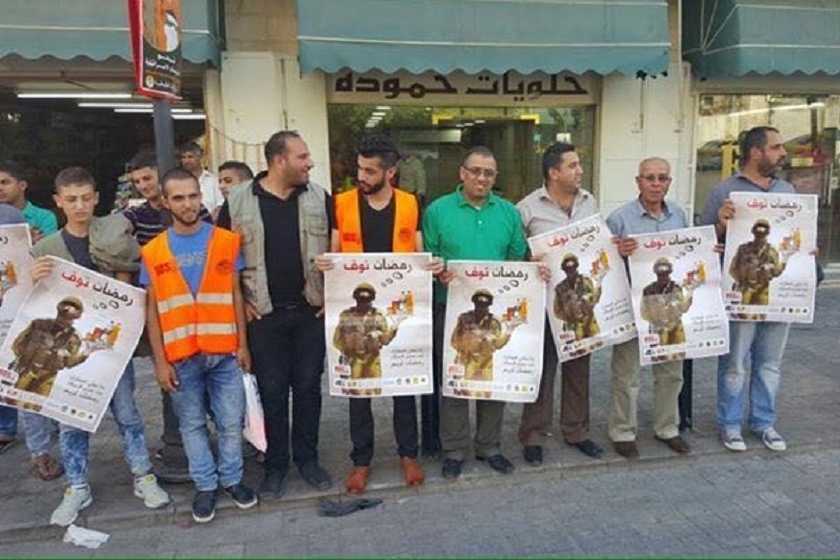
Entitled "Ramadan Tov" - meaning "Happy Ramadan" in Hebrew - the campaign has brought together a majority of the local Palestinian boycott movements for the first time under the umbrella of the international Boycott, Divestment and Sanctions (BDS) group.
It aims to encourage Palestinians to boycott Israeli products, food data-x-items in particular, during Ramadan, and afterwards. The targets are the biggest Israeli food companies including Jafora, Tnuva, Strauss and Osem. The face of the campaign is an Israeli soldier in his distinguishable green uniform serving a tray of popular Israeli food products regularly consumed by Palestinians during the holy month.
"We are working on raising awareness about the negative impact of Israeli products on the local market. We try to show the connection between these products and tangible Israeli violations against the rights of Palestinians, represented through the army and the settlers," Hazem Abu Helal, a member of the local BDS committee, told Al Jazeera.
Established in 2005, BDS is a Palestinian-led global movement that calls for an economic, academic and cultural boycott of the Zionist regime until it complies with international law and grants Palestinians their rights.
Abu Helal says that one of the factors that sets this campaign apart from previous ones is the use of the word "tov" which he says is "provocative" for many Palestinians because it is a Hebrew word.
Activists have launched the campaign across major Palestinian cities such as Ramallah, Bethlehem and Nablus. They are putting up posters, staging protests in front of the headquarters of selling agents and distributors of Israeli goods, speaking to people on the streets and placing provoking stickers on products.
By pointing out what they see as the irony of funding one's occupier, activists hope to deter Palestinians from consuming any Israeli goods.
Fareed Taamallah, a member of the local "Support your Occupation Boycott" initiative based in Ramallah, believes that boycott awareness is gradually increasing among Palestinians. "The local boycott campaign generally intensifies and retreats depending on the security conditions and the situation on the ground. For example, during the last offensive on Gaza in 2014, the boycott campaign was at its peak but receded after the war ended," said Taamallah.
Despite believing that the joint-campaign is a major step forward for the Palestinian political landscape, Abu Helal says that there is "certainly no consensus on the subject of boycotting in Palestinian society".
"We confront a government of occupation and a Palestinian government that is weak and cannot take control of anything on the land," said Abu Helal, explaining the reasons behind the lack of consensus over the need to boycott Israel.
As part of the campaign, activists have been posting a fact sheet on social media highlighting the direct link between the products and Israeli violations of Palestinian rights.
One post reads: "Did you know that Jafora, the company that produces Tapuzina juice and Ein Gedi water is a conglomerate between the two companies Jafora and Tavori, which take pride in their support for Zionist gangs during the Nakba?"
Another says: "Did you know that Tnuva distributed milk and dairy products to the occupation forces for free during the 2014 war on Gaza, due to pride in the army's operations against our people?"
The group says that conducting such campaigns restores hope among the people that boycotting is a legitimate form of resistance.
Early last month, Israel imposed a travel ban on BDS cofounder Omar Barghouti, a move seen as an attack on freedom of speech and human rights activists.
"Boycotting has a direct impact on Israeli politics. For example, last month, the PA decided to block Israeli dairy products from entering the West Bank market in response to the blocking of Palestinian dairy products in Jerusalem. Israel went back on its decision immediately," said Taamallah.
"I urge all the free people in the world to pressure Israel through boycott. It is one of the permitted methods of resistance to its colonial and racist policies."
