

Seoul Restaurants Adapt to Muslim Tourist Boom with Halal Menus

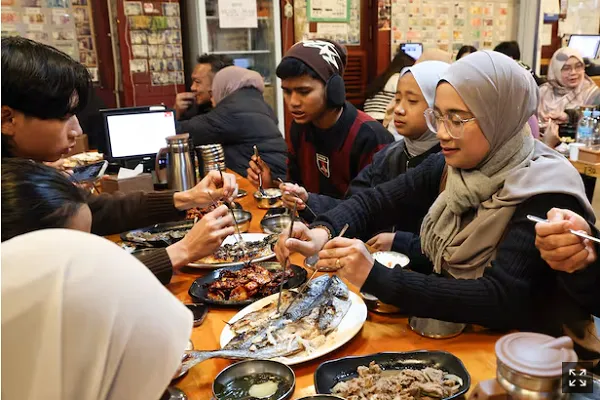
At 6:30 p.m. on the 26th (of December 2025), a grilled fish restaurant near Sinchon Station in Seoul’s Seodaemun District was packed, with no empty seats.
Around 40 customers, mostly Muslim tourists wearing hijabs, pointed to photos on the menu and shouted “This one!” to the staff. As grilled mackerel, Spanish mackerel, and spicy stir-fried squid arrived, they exclaimed, “Terbaik (the best)!”
This restaurant was originally popular among university students. However, after gaining a reputation as a “Halal restaurant” among Muslim tourists, foreign sales now account for 70% of its revenue. “Halal” means “permitted” in Arabic and refers to food permissible under Islamic law.
Read More:
As more Muslim tourists come to Korea, their “food map” is changing. Previously, Muslims often visited Itaewon to eat kebabs or lamb. Now, they actively seek Korean restaurants that meet Halal standards.
According to the Korea Tourism Organization, Muslim tourists increased from 360,000 in 2022 to 800,000 in 2023. Last year, 1.03 million visited, and as of October this year, 998,000 have arrived, suggesting the number will exceed 1 million for the second consecutive year.
However, only about 15 restaurants nationwide have received Halal certification from the Korea Islamic Federation (KMF) Halal Committee. As a result, Muslim tourists share information about “Halal-friendly” restaurants via social media and dedicated food and travel apps. They visit eateries that avoid pork and alcohol or focus on seafood and vegetables, then share reviews.
Around 1 p.m. on the 26th, a Korean restaurant in Myeongdong, Jung District, was crowded with Muslim tourists. Foreigners in hijabs lined the stairs and corridors. Several families with children in strollers ordered Budae-jjigae and kimbap prepared without processed meat. A sign on the wall read, “Prayer room available.”
Restaurants in Myeongdong, Sinchon, and Bukchon—areas popular with foreign tourists—are gaining popularity by offering Muslim-friendly dishes like kimchi fried rice without salted seafood and Budae-jjigae made with soy meat. Mr. Sim, 59, who runs a Korean restaurant in Myeongdong, said, “We no longer use processed meat due to the increase in Muslim tourists.”
Muslims also frequent temple food restaurants. At 11:30 a.m. on the 26th, women in hijabs lined up at a temple food restaurant in Insadong, Jongno District. The restaurant’s sign read “Vegan Restaurant.” The women ordered dishes like soybean bulgogi wraps, shiitake rolls, and plum sauce with mushroom tempura instead of meat. Employee Song Taehyun, 30, said, “We also run cooking classes for Muslim customers interested in temple food recipes.”
Professor Jeong Ran-su from Hanyang University’s Tourism Department noted, “Muslim tourists’ consumption patterns are evolving from a passive phase of seeking familiar foreign food to an active phase of exploring and consuming Korean cuisine within their religious standards.”
Source: chosun.com
