


A Translation of Quran into Ukrainian by Shia Muslims
IQNA – Ukraine is one of the Eastern European countries where Islam has the largest following after Christianity.
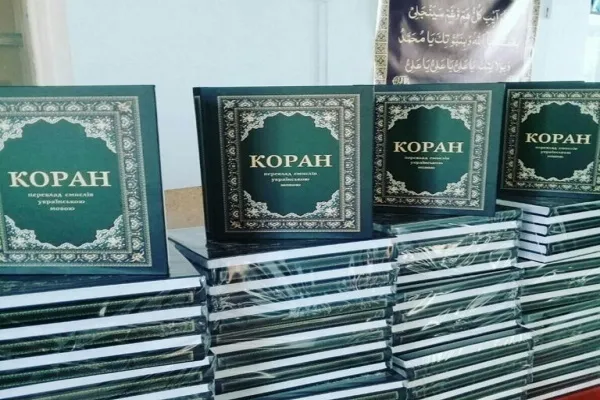
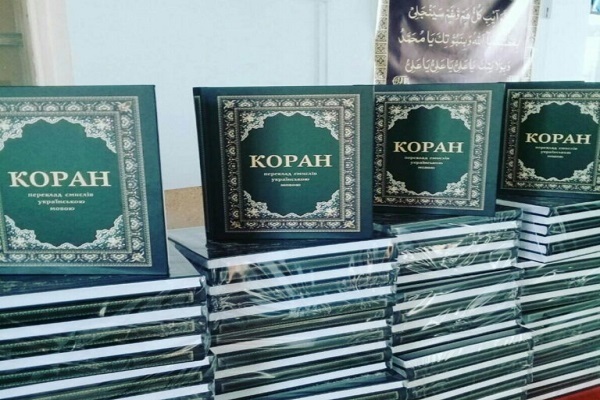
The arrival of Islam in Ukraine dates back to the first half of the 10th century, when Muslim traders visited the country. Islam entered the country from the south, from the Arab countries and Turkey, and from the east, from the Caucasus.
Muslims live in the majority on the Crimean peninsula. The Pew Research Center has estimated the Muslim population in Ukraine to be around 393,000, while the Center for Muslim Affairs in Ukraine estimates the Muslim population at around 2 million.
According to the some statistics, around 100,000 of the Ukrainian population are Shia Muslims. The Shias in this country are mostly immigrants from the Republic of Azerbaijan, Iran, Kazakhstan and Uzbekistan.
After the collapse of the Soviet Union and the independence of Ukraine, the Shias in this country began their missionary activities, and some Ukrainians also became followers of the religion of Ahl-ul-Bayt (AS). The Shias in Ukraine have observed the mourning rituals of Ashura for many years.
With the increasing Shia population in the country, the need to translate Islamic and Shia texts into Ukrainian has become more and more felt. The Holy Quran is at the forefront of Islamic texts that have been translated into this language several times.
Following is an article by Mykhaylo Yakubovych about the first translation of the Quran into Ukrainian done with a Shia approach.
The story of the most recently published Quran translation into Ukrainian has its origins in the activities of the Ukrainian Shia Twelver community, specifically the Ahli-bayt Center of Islamic Culture in Ukraine and Eastern Europe.
Primarily comprising members of the Azerbaijani and Iranian diasporas in Ukraine, local Shia organizations are especially active in Kyiv, Kharkiv and Dnipro, and are found mainly in the east of the country (although many foreigners have left the country after the Russian invasion in 2022). Although these organizations predominantly use the native languages of the local Shia diasporas, or Russian (as a language of intercultural communication), in the late 2010s this religious network also made some attempts to ‘Ukrainize’ some of the most fundamental religious texts of Islam. These texts were translated with a missionary purpose, primarily for the purpose of competing with the Sunni Muslim communities that have been promoting a lot of religious printed materials in Ukrainian over the last decade. The Quran translation project finally came into fruition in 2021, when the first edition of Koran: Pereklad smysliv Ukrainskoyu movoyu was made available in Kyiv and Kharkiv. This was actually the fourth complete translation into Ukrainian.
Read More:
Koran: Pereklad smysliv Ukrainskoyu movoyu begins in a quite a promising manner: after providing a short history of the translation of the Quran into Ukrainian, it reveals that the work is a team effort undertaken by four translators. The head of the project, and the leader of the translation group, is Namik Babakhanov, a Ukrainian preacher of Azerbaijanian origin with two degrees in Islamic Studies, from Al-Mustafa International Islamic University (Iran) and the Islamic University of Baku, Azerbaijan. The translation, according to information given in the preliminary material, is based on the Arabic original, as well as numerous translations into Persian, Turkish and Russian. However, as the translation contains no footnotes or commentary of any kind, it is hard to come to any definite conclusions about the use of any exegetical sources. There is an obvious tendency to rely on Shia sources: not only in its apparent reliance on the well-known Shia Quran translations by Elahi Qomshei and Makarem Shirazi, but also in the way that it counts the bismillah as a part of the first verse in almost all Surahs, with the exception of the Fātiḥah (in which it is treated as an independent verse) and Q 9 ‘in accordance with a ḥadīth from Imām Jaʿfar al-Ṣādiq.’ This is unusual even for Shia translations, most of which usually treat the bismillah as coming before the first verse rather than being part of it, as do the vast majority of other translations, be they produced by Muslims or non-Muslims.
When it comes to the core text of the book, the translation, this appears to be a more or less faithful reproduction in Ukrainian of the Russian Quran translation by Magomed-Nuri Osmanov (1924–2015). The selection of this work would appear to be no coincidence: first of all, in addition to Sunni sources, Osmanov also made recourse to the Shia exegetical tradition (including the opinions of Ayatollah Khomeini in its commentary). Secondly, an edition of Osmanov’s translation was published in Iran in 2000. This meant his work was more sympathetically received by the Russian-speaking Shia community than, for example, any of the Russian Orientalist translations (such as that by I. Krachkovskij ) or recent Sunni-Salafi interpretations (such as that by E. Quliyev). Still, for obvious confessional reasons, a few verses underwent some changes: the most illustrative case is Q 5:6, which includes a major point of interpretive difference on the issue of wuḍūʾ (ritual abolition) practices in the Shia and Sunni traditions. While Osmanov translates the verse in a way such that it prescribes washing one’s legs in the same way as one’s hands, Babakhanov and his team make a change here, and the Russian ‘provedite [mokroj rukoj] po golove i pomojte nogi do schikolotok’ is converted into ‘provedit’ (moktoju rukoju) po golovi ji nogah do schykolotok’, i.e., excluding the verb ‘myty’ (‘to wash’). Thus, while the Russian text recommends washing one’s legs, the Ukrainian one directs one to only wipe them with a wet hand.
There are a number of other interventions into Osmanov’s vocabulary in Koran: Pereklad smysliv Ukrainskoyu movoyu, like changing the divine name al-Ṣamad (Q 112:2) from ‘Vechnyi’ (‘The Eternal one’) to ‘Samodostatnij’ (‘The Self-Sufficent’’), but such ‘corrections’ generally appear to be rare. Some of the translations are really strange: for example, when translating the description in Q 77:20 of sperm as māʾ mahīn (‘a disdained liquid’), Osmanov rendered this as ‘prezrennaya vlaga’ (lit. ‘a miserable liquid’), while Babakhanov and his team opted for ‘hanebna vologa’ (‘a shameful liquid’) instead. This seems to stray too far from the explanation of māʾ mahīn that is usually provided in commentaries, where it is described as meaning ‘weak’ or ‘small.’ It appears that the translators simply got the wrong impression of Osmanov’s use of the Russian word ‘prezrennaya,’ which, in a different context, could have a meaning similar to ‘abject’ or ‘dishonorable.’ This appears to be a standard case of improper translation caused by reliance on another translation, rather than the original Arabic text.
Read More:
Namik Babakhanov’s translation is one of three recent Shia translations that have recently been published in Slavic languages as an alternative to Sunni readings (on Nazim Zeynalov’s Russian translation. According to information provided by Shia community members in Kharkiv, there is also an ongoing project to translate Nazim Zeynalov’s work into Ukrainian. Such projects remain relatively unpopular among their potential readership, not only because of their strong confessional associations, but also because of their reliance on secondary texts, i.e., because they are actually translations of another translation.
Source: gloqur.de
