


Imam Khomeini’s Message Derived from Quran: Sachedina
IQNA – In an interview in 2015, Abdulaziz Sachedina, a former professor of Islamic studies at George Mason University in Virginia, USA, said Imam Khomeini’s (RA) message, which originated from the Quran, was universal and addressed all Muslims.
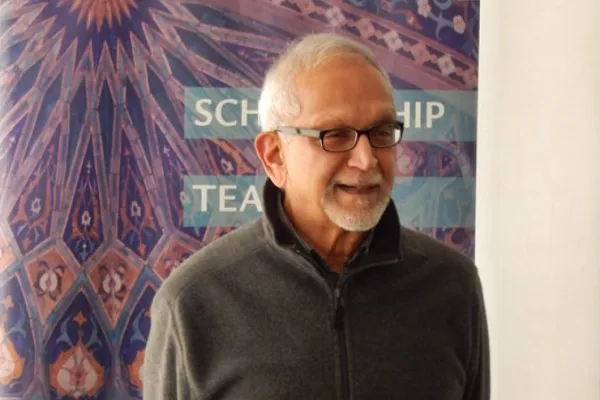
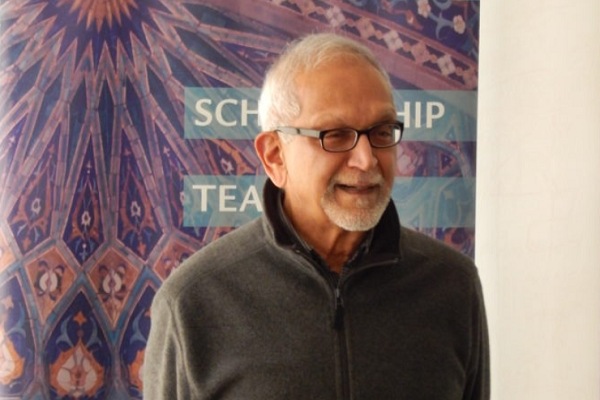
Professor Sachedina, a leading Muslim scholar in comparative Islamic studies, Shia theology, bioethics and human rights, died at the age of 83 in Virginia, on Wednesday.
He was regarded as one of the most influential contemporary scholars of Islam. Born to a Shia family of Indian heritage in Tanzania, East Africa in 1942, he received his early education there.
His multicultural upbringing exposed him from an early age to questions of identity, tolerance and interfaith dialogue—concerns that would shape his entire academic life.
As a teenager, he moved to India to study the humanities at Aligarh Muslim University. He then traveled to Iran to deepen his understanding of Shiism, studying both seminary and university courses at Ferdowsi University of Mashhad. It was during this period that his deliberate effort to bridge “textual study” with “scholarly method” began to take shape.
A decisive step in his intellectual trajectory came with his move to Canada, where he pursued his master’s and doctoral studies at the University of Toronto.
His PhD dissertation on the “development of Mahdism in Imami Shiism” later formed the basis of his influential book Islamic Messianism.
Sachedina began his academic career in the 1970s and taught for more than three decades at the University of Virginia as a professor of religious studies.
He later joined George Mason University as the holder of the IIIT Chair in Islamic Studies. His teaching covered a wide range of fields, including Islamic theology (Shia and Sunni), the history of Islamic thought, Islamic bioethics, Islam and human rights, religious pluralism, and comparative Quranic studies.
Beyond teaching, he played an active role in intellectual institution-building, interfaith dialogue, and medical ethics committees.
Among his many publications, some of the most notable are Islamic Messianism: The Idea of Mahdi in Twelver Shi‘ism, The Just Ruler in Shi‘ite Islam, Islamic Biomedical Ethics, Islamic Roots of Democratic Pluralism, and Islam and the Challenge of Human Rights.
Read More:
He also authored numerous articles on ethics, contemporary jurisprudence, comparative theology and interfaith studies.
In an interview with IQNA in 2015, he talked about the universal message of the late founder of the Islamic Republic of Iran, Imam Khomeini (RA).
He spoke to IQNA on the sidelines of an international conference held in Tehran that year on “The Holy Quran in the Life and Thought of Imam Khomeini (RA)”.
“I have been invited to this conference to present an article about the relationship between the great leader of the Islamic Revolution of Iran (Imam Khomeini) and the Holy Quran. I believe this conference is a very meaningful event because we are in a period in which we must refer to Imam Khomeini (RA) and the Quran to find out exactly what is in the Quran that Imam Khomeini used in his revolution and included in his ideal for the Iranian nation and the Muslims of the world.”
Sachedina added, “From the perspective of the late Imam, the Quran is of great importance as a source of inspiration, and the Imam’s message, which originated from the Quran, is universal and addresses all Muslims in all parts of the world. I can go further and say that if anyone in today’s world thinks about the spiritual dimension of human existence and the message that the Quran has presented about spirituality, he can listen to Imam Khomeini’s message, which is derived from the Quran.”
Explaining what he meant by Imam Khomeini’s (RA) “global message” in the present era, the scholar said, “The most important issue facing the global community and the Islamic Ummah is preserving what is called ‘the meaning and nature of good and evil’. We are seeking to achieve a balance, a balance between the two extremes of extremism that we face today; extreme materialism and extreme violence in religion and beliefs like Daesh (ISIL or ISIS) and many other examples of this kind.
“Today, many societies are on the path of extremism, and therefore it is necessary to choose the middle ground instead of extreme materialism, extreme wrong perception of spirituality, extreme in individual, family, ethnic, social, national and international affairs. In such circumstances, it is possible to find one person who can influence the individual, group, society, nation, and the world community. Therefore, one can start from the individual and reach the nation that Imam Khomeini founded.”
Read More:
Sachedina added, “With a baggage of experience at the age of 73 and living in different parts of the world, I can today be proud of what Imam Khomeini taught us many years ago. What the Imam taught us was universal. He taught us to focus our attention on man as the essence of God’s creation. It is man who is important because he is God’s vicegerent on earth and God’s spirit flows in him.

The historian and researcher of Islamic sciences continued by referring to the famous poem by the famous Iranian poet Saadi:
“Human beings are members of a whole
In creation of one essence and soul
If one member is afflicted with pain
Other members uneasy will remain
If you have no sympathy for human pain
The name of human you cannot retain.”
He said in this regard, “This poem by Saadi can be clearly seen in the life and tradition of the Prophet of Islam (PBUH). Imam Khomeini (RA) also emphasized that part of a person’s religious and spiritual responsibility includes thinking about and caring for the situations of others. In the Imam’s view, if someone is indifferent to others, they will fall into selfishness and complacency and will fall to the point where they no longer realize their moral duty, and this is a big problem. In today's interconnected world, where means of communication have made people aware of each other’s situation, we have no right to be indifferent to each other. This is what Imam Khomeini taught us.”
Referring to verse 70 of the Holy Surah Al-Isra, Sachedina said: God has given honor and respect to all human beings, regardless of gender, race, ethnicity, belief, etc.
“The word ‘Adam’ in the Quran represents the common noun for man. This is the same spirit of the Quran that is also found in the message of Imam Khomeini (RA).”
4320954
