


Global Scholars Gather in New Delhi for Quran and Science Int’l Conference
IQNA – Jamia Millia Islamia (JMI) in New Delhi, India, launched a major three-day international conference on Wednesday, gathering scholars from across the globe to delve into the dynamic interface between Quranic teachings and contemporary scientific advancements.
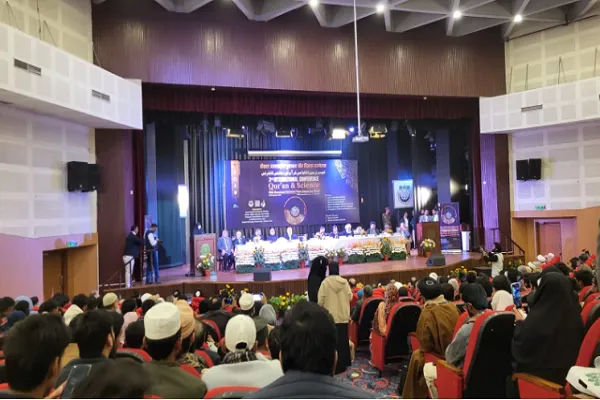
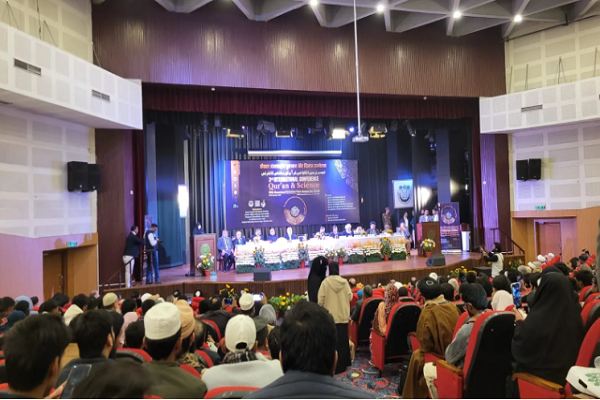
The inaugural session began with the recitation of the Holy Quran, followed by a ceremonial presentation of bouquets, shawls, and mementoes to the distinguished guests. Prof. Junaid Haris introduced the guests, while Prof. Shahid delivered the welcome address, underlining the importance of sustained dialogue between religion and modern knowledge systems.
Addressing the gathering, Dr. Aslam Parvaiz, former Vice-Chancellor of Maulana Azad National Urdu University (MANUU), Hyderabad, described the conference as a crucial academic initiative. He challenged the widespread perception that religion is confined to rituals alone, emphasizing that the Holy Quran repeatedly urges human beings to use their intellect and senses. Quoting Quranic references, he said, “The Quran declares that those who do not use their reason are no better than animals.” He added that while the universe functions according to divine laws, humanity must reflect on whether it truly follows those principles in daily life.
Engineer Mustafa Abbas from Kuwait posed thought-provoking questions to the audience, asking whether the Quran remains relevant in the age of rapid technological advancement. “Do we obey Quranic principles as strictly as we obey traffic rules?” he asked. Stressing the enduring relevance of Quranic guidance, he said the Holy Quran offers timeless values and knowledge essential for individual growth and social harmony.
Global Perspectives and Contemporary Challenges
Addressing the audience, Prof. Jamileh Almolhoda, wife of former Iranian President Martyr Ebrahim Raisi, said that such conferences were initiated to address growing misunderstandings about the Holy Quran. She noted that incidents of Quran desecration around the world reflect ignorance rather than knowledge. Expressing concern over weakening family structures, she said that younger generations, particularly Gen Z, are increasingly vulnerable due to lack of parental guidance. She warned that blind adoption of Western ideologies without ethical grounding poses challenges to social stability, and stressed that Quranic knowledge provides a comprehensive framework to confront these issues.
Renowned Islamic scholar Prof. Akhtarul Wasey congratulated Jamia Millia Islamia for organizing the conference at a time of significant global and geopolitical challenges. He stated that the Quran has shed light on several aspects of modern science while consistently encouraging humanity to reflect on the universe and its creation. “There is no contradiction between the Quran and modern science,” he asserted, adding that the Quran’s primary purpose remains the moral and spiritual guidance of humankind.
Read More:
Dr. Mohammad Fathali, Ambassador of the Islamic Republic of Iran to India, highlighted that discussions on the relationship between the Quran and science have continued for centuries. He said the Quran promotes knowledge, reasoning, argumentation, and ethical values, which remain deeply relevant in addressing contemporary global challenges.
Understanding the Quran in the Modern Age
Raising a fundamental question of modern times, Dr. Kalbe Jawad asked why a book revealed over 1,400 years ago should still be studied today. He argued that several Quranic insights align with scientific discoveries that were confirmed centuries later. He urged students and researchers to study modern science through the light of the Quran, cautioning that scientific theories often change and are revised over time.
In his presidential address, Prof. Mazhar Asif, Vice-Chancellor of Jamia Millia Islamia, offered a reflective observation on the Muslim engagement with the Holy Quran. “We read the Quran, but we do not understand it; and even when we understand it, we do not follow it,” he remarked. Emphasizing the need to translate Quranic teachings into everyday practice, he highlighted values such as mercy, compassion, and justice. Referring to divine attributes reflected in human responsibility, he urged the audience to embody mercy and ethical conduct in social interactions.
A special highlight of the inaugural ceremony was the launch of a scholarly book, followed by keynote addresses by distinguished international scholars.
Read More:
Prominent speakers included Prof. Ali Akbar Salehi (Iran), Prof. Oliver Scharbrodt (Sweden), and Ayatollah Prof. Abdolmajid Hakim Elahi (Iran), who shared insights on faith, ethics, science, and global responsibility in an increasingly interconnected world.
The conference is jointly organized by the Department of Islamic Studies, Jamia Millia Islamia, Welayat Foundation, New Delhi, and Shahid Beheshti University, Tehran, Iran, and will continue with technical sessions and academic discussions for three days.
Source: muslimmirror.com
