


Information Ethics from Perspective of Quran
IQNA – The Noble Quran urges people to investigate the truth of any news and information they hear and not to accept anything based on assumption, an Iraqi scholar said.
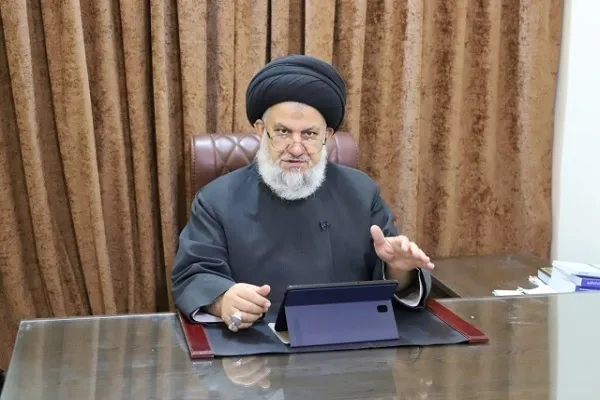
Ayatollah Sayyid Fadhel Al-Jaberi spoke about the enemies’ information and psychological war amid the US-Israeli aggression on Iran and Lebanon.
The text of his speech as follows:
The Almighty God has stated in His Holy Book: “O you who have believed, if there comes to you a wicked person with news, investigate, lest you harm a people out of ignorance and become remorseful over what you have done.” (Quran 49:6).
In this blessed verse, a comprehensive ethical, fundamental, and social principle has been explained, which we can call the sociology of the Quran. This rule wants to emphasize that hearing the words of a wicked person is not a problem; rather, the problem is believing the words of a wicked person without investigation and without research.
Many things are heard in society, in the streets, in schools, on social media, on television, and in various channels. However, the principle is that any word that is not based on clear evidence should not be believed.
This verse is actually a call to free the mind from blind following and a request to rely on evidence in forming thoughts and believing opinions.
Why does the Noble Quran emphasize the confirmation and clarification of news? What is its philosophy? At the end of the blessed verse, it states: “…lest you harm a people out of ignorance and become remorseful over what you have done.”
Remorse is the inevitable consequence of relying solely on conjecture; simply hearing something from someone and judging others based on that word, which was spoken without any proof or evidence.
Even now, in our jurisprudential discussions, for example, we do not consider a narration valid or believe in its authenticity unless we are sure of the reliability of the narrator. The narrator must be trustworthy for us to say that what he has narrated is reliable. But if he is not trustworthy and we are not sure of his trustworthiness, this narration has no value. We discard it. So how can we judge a believing man or woman based on baseless words from here or there? Isn’t this foolish? Isn’t this a kind of intellectual slavery to others and blind following of them?
In the era of digital technologies, represented by social networks and various television channels, we see that a single click can lead to the character assassination of an individual. For example, a post on social media seems like a rumor and a lie, and it presents false information that damages the character of a believing man or woman. Just by pressing the share button, I have contributed to the destruction of a home, a character, an institution, an organization, or something similar.
Read More:
Dear ones, do not follow conjecture, for conjecture has no value against the truth, and the Almighty God holds accountable every word that a person utters.
“[Man] does not utter any word except that with him is an observer prepared.” (Quran 50:18).
Praise be to Allah, the Lord of the worlds, and may Allah’s blessings and peace be upon Muhammad and his pure household.
4335914
