


Pope’s Criticism of Trump’s Warmongering: A Confrontation between Faith, Power
IQNA – The Catholic Church leader’s recent criticism of US President Donald Trump represent a confrontation between faith and power and present the pope as an international counterweight to Trump’s policies.
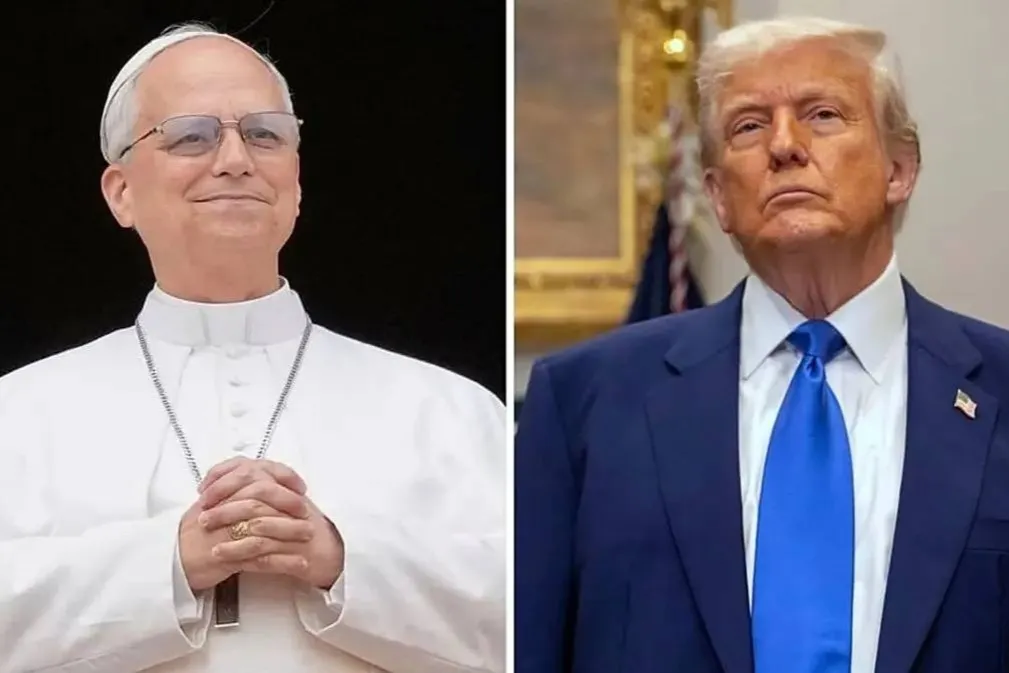
This is according to an article by Ali Marouf Arani, a researcher in the field of Zionism and Judaism, which is as follows:
This article depicts, in a way, a confrontation between faith (represented by the Pope) and the power of rebellion against religion (represented by Trump). It attempts to show how the pope, contrary to the usual practice of past popes, has directly challenged the US president.
While Pope Leo XIV’s pacifist message and his opposition to the war on Iran have been widely welcomed, his confrontation with Donald Trump’s warmongering approaches has taken on new dimensions. The negative reactions to Trump’s controversial action of publishing a picture of himself as Jesus Christ and insulting Pope Leo, which led to an increase in the distance between him and his religious base, have revealed signs of weakening his political position. The decline in public satisfaction and the intensification of domestic criticism have reinforced the speculation that Trump will face serious challenges in the upcoming midterm elections.
The war of words between Trump and Pope Leo has escalated at a remarkable pace. But a look at history shows that this clash between political and secular power has a thousand-year history.
Pope Leo XIV’s trip to Africa and Algeria, which is largely Muslim, began after he strongly criticized US military operations in Iran. The move has highlighted the pope’s position as a counterweight to the Trump administration. The pope’s willingness to challenge the US president on the world stage reflects a significant escalation of tensions between Washington and the Vatican.
Donald Trump and his vice president, J.D. Vance, have made a series of harsh statements against the leader of the Catholic Church this week, while the pope, who said earlier this week that he had “no fear of the Trump administration,” shows no sign of backing down.
Pope Leo XIV, the world's Catholic leader, previously took the strongest stance against the war on Iran, blaming the “illusion of omnipotence” for escalating attacks on Iran and calling for peace. He said: “Enough egoism and greed! Enough show of power! Enough war!”
In contrast, Trump expressed his anger at the pope’s opposition in a message and attacked him, claiming in a message on Truth Social that Pope Leo is weak against crime and acts disastrously in foreign policy.
Since the start of the war on Iran, the pope has repeatedly called for peace in the Middle East, emphasizing that God does not bless any conflict and warning against the illusion of omnipotence.
Read More:
In a lengthy social media post, Trump, in turn, derided Pope Leo as “weak on crime, and a disgrace on foreign policy,” telling him to “focus on being a great pope, not a politician.”
“I have no fear of the Trump administration or of speaking out about the message of the Gospel, which is what I believe I am here to do, what the Church is here to do. We are not politicians,” Pope Leo XIV said. “We do not approach foreign policy from the same perspective that he might understand it, but I believe in the message of the Gospel as a pacifist.”
The messages highlight Trump’s unprecedented attacks on social media and the Pope’s direct response to him. The confrontation has been described as a struggle between faith and power.
Pope's outspoken criticism of Trump's warmongering
In this scenario, Pope Leo XIV declares that he has no fear of the Trump administration and will continue to speak the message of God. He criticizes the misuse of the Bible and emphasizes the need to find a better way.
The pope's remarks present him as an international counterweight to Trump's policies. The confrontation between the first American pope and the US president has been described as unprecedented.
Pope Leo XIV's remarks point to his background in the Order of Saint Augustine and his emphasis on unity and bridging. He focuses on listening and gradual change rather than hasty action, highlighting the importance of multilateral institutions and international law.
Pope Leo (in this scenario) is described as more conservative and reserved than Pope Francis, but the US military operation has forced him to speak with clarity of tone.
The pope rarely mentions US political leaders by name in his messages and speeches about the start of the war against the Islamic Republic of Iran, but he does mention Trump personally. This, along with the allusion to the US secretary of defense (Pete Hegsett) about the prayer of warmongers, shows the depth of the disagreement.
In Africa, the Pope presents a message of peace, stating that “the world is being destroyed by a handful of tyrants” and “woe to those who use religion and the name of God for their military, economic or political interests.”
Following this enlightenment by Pope Leo XIV, the reaction of US Vice President J.D. Vance is worth considering. Vance said in his remarks that he was urging the pope to “be careful” when speaking about theology and to remember the “just war” theory.
Why did the pope choose Lampedusa instead of the United States for the anniversary of independence?
It is expected that the pope will not visit the United States while Trump is president and will instead spend the anniversary of America’s independence on the island of Lampedusa (a migrant arrival center), which is a symbolic message.
The Vatican has announced that the pope will not visit the United States in 2026. This news is significant in itself, because a papal visit to the United States is usually considered a major diplomatic and religious event and can be a sign of tension or unwillingness to engage at the highest level.
Read More:
Instead of traveling to the United States, the pope has decided to spend the Fourth of July (the 250th anniversary of America’s independence) on the island of Lampedusa in southern Italy. This choice of location and time is very significant because choosing to spend this day somewhere other than the United States could symbolically be seen as a negation or disregard of America’s core celebrations on its founding anniversary. This can send a strong message, especially when confronted by the president of the United States.
As for the island of Lampedusa, in southern Italy, it is one of the main points of entry for migrants into Europe, especially from Africa and the Middle East. The pope has always paid special attention to the issues of migrants, refugees and the poor. The choice of Lampedusa as the location for this important day reflects the pope’s prioritization of issues related to migration and humanitarian crises, which often conflict with the strict immigration policies of the Trump administration. This choice positions the pope as a defender of human rights and those who have been harmed by Trump’s policies.
It is difficult to imagine the pope visiting his birthplace while Trump is president. These events and actions between the parties show that Pope Leo XIV’s lack of travel is directly attributable to the political and moral tensions between the pope and Trump. In other words, the political climate and disagreements are so great that an official or even unofficial visit by the pope to the United States is impossible or undesirable.
In short, the tension between the pope and Trump has reached such a level that even an important event such as the anniversary of American independence, instead of being an opportunity for rapprochement, has become a scene of opposition and a priority for the Pope to focus on humanitarian issues (such as immigration).
Read More:
The pope also clearly states that the people do not consider a war on Iran to be just, which indicates his firm stance against Trump's foreign policy.
Overall conclusion:
Looking at this long perspective, the confrontation between Trump and Pope Leo seems less surprising. When a president uses sacred language or imagery to justify violence and the pope responds by denying divine approval, they are recreating a struggle as old as medieval Christendom: who can speak in the name of God and who can set limits to power.
The medieval world did not resolve this tension, but it learned to cope with it by dividing authority: first between church and throne, and later between rulers and the law. What is troubling today is how easily modern leaders still resort to religious language to escape constraints, and how fragile the institutions that are supposed to restrain them seem.
4347383
