


US Joins Israeli Crackdown, Sanctions Gaza Flotilla Activists
IQNA – Organizers of international solidarity flotillas trying to deliver aid to Gaza now face US asset freezes and travel bans, after Washington imposed sanctions on four key figures amid a broader Israeli naval crackdown on the protest vessels.
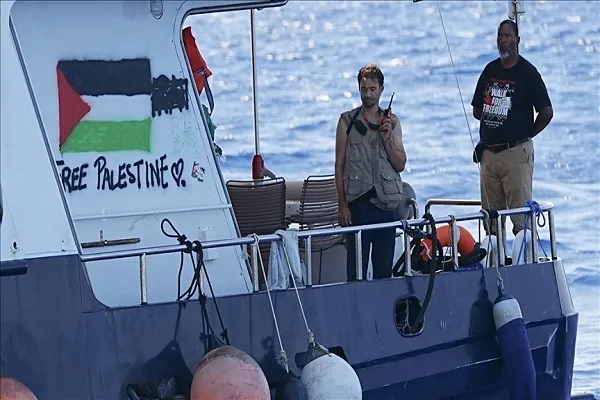
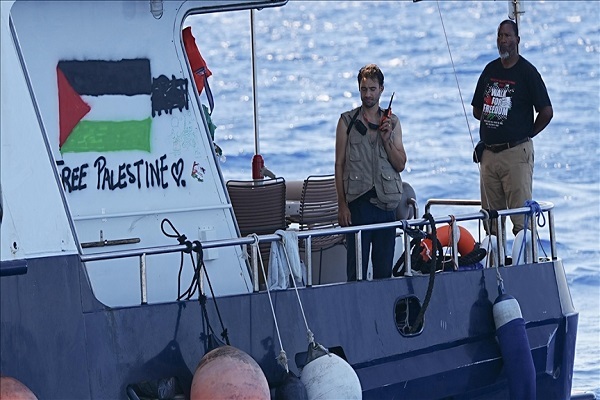
Without providing evidence, the US alleged that organizers of the vessels are trying to reach the Palestinian territory “in support of Hamas”.
The sanctions on Tuesday come as the Israeli regime military continues to intercept the latest fleet of Gaza-bound ships.
While the humanitarian crisis from the Israeli blockade on Gaza has eased since the “ceasefire” brokered by US President Donald Trump came into effect in October, Palestinians have continued to suffer from shortages, including in food and medical supplies.
International activists have been sailing towards Gaza in an effort to defy the blockade and show solidarity with Palestinians.
“The pro-terror flotilla attempting to reach Gaza is a ludicrous attempt to undermine President Trump’s successful progress toward lasting peace in the region,” Treasury Secretary Scott Bessent claimed in a statement on Tuesday.
“Treasury will continue to sever Hamas’ global financial support networks, no matter where in the world they are.”
Despite the truce, Israel has been regularly bombing Gaza, killing at least 880 people since the “ceasefire” came into effect. The enclave also remains almost entirely destroyed, and reconstruction has not meaningfully started, leaving hundreds of thousands of people living in tents.
The US sanctions on Tuesday targeted two representatives from the advocacy group Popular Conference for Palestinians Abroad (PCPA) and two others from the Palestinian prisoners solidarity network Samidoun.
The US imposed sanctions on the PCPA in January for backing the flotillas. Washington had also previously blacklisted Samidoun, but Tuesday’s penalties were specifically about the vessels.
One of the organizers, Samidoun’s Mohammed Khatib, had been previously detained in Belgium and Greece for his activism. His colleague Jaldia Abubakra, who took part in the Global Sumud Flotilla in August of last year, was also sanctioned.
The targeted representatives of PCPA were Saif Abu Keshek, who was detained by Israel and deported earlier this month after taking part in the flotilla, and Hisham Abu Mahfouz, the group’s acting secretary-general.
Activists reject sanctions
Huwaida Arraf, a Palestinian American activist who has been one of the organizers of the flotillas, said the premise of the sanctions – that the vessels are somehow connected to Hamas and they undermine peace efforts – is “ridiculous”.
“The context is rejected. The facts are absolutely wrong, and all in all, it is just another attempt by the Trump administration and the US as a whole to break Palestinian solidarity efforts,” Arraf told Al Jazeera. “And it won’t work; it won’t work.”
Samidoun said the penalties against Khatib and Abubakra are “the latest manifestation of the ongoing US genocidal war on the Palestinian people”.
“Today’s sanctions by the US come hand in hand with today’s Israeli piracy of the Global Sumud Flotilla and the Freedom Flotilla and the abduction of hundreds of international activists at sea,” the group told Al Jazeera in a statement.
“All of these sanctions targeting Palestinian organizations, not only those targeting us, are aiding and abetting genocide.”
DAWN, a US-based rights group, rejected the sanctions against flotilla organizers on Tuesday.
“Every time Palestinians and their supporters organize internationally, Washington reaches for the terrorism label to shut them down,” Isabelle Hayslip, advocacy manager at DAWN, told Al Jazeera.
“The net keeps widening. Palestinian diaspora communities now live under constant threat of designation for demanding their rights.”
Human rights advocates have launched dozens of vessels over the past two years, but they have all been intercepted by the Israeli military in international waters. The effort to send civilian boats to break the siege on Gaza dates back to 2008. Before Israel’s genocidal war on the enclave, several vessels succeeded in reaching the territory.
In 2010, Israeli forces raided the Freedom Flotilla and killed nine unarmed activists.
Arraf said throughout the years, the goal of the vessels has not been merely to deliver aid but to break the blockade.
“Our boats are never going to be able to carry enough aid, and Palestinian people don’t want to survive on aid, so that’s not the main goal,” she said.
“We’ve been trying to break the blockade for decades because it is unlawful and it is deadly, and it has most recently been used as a tool of Israel’s genocide.”
Arraf added that the “direct action” of the flotilla is part of a broader political campaign and activism to push governments around the world to act and uphold the rights of Palestinians.
“When we organize each flotilla, it’s part of what’s chipping away at Israel’s impunity. It’s exposing it and exposing our governments’ complicity,” she said, stressing that Israel’s interception of the ships does not mean that they failed.
Activists have argued that the Israeli raids on the ships are illegal, likening them to piracy.
“It’s to be stressed that everybody sailing is sailing lawfully in international waters when we’re attacked,” Arraf said. “Even if we reached Palestinian waters, it would be lawfully going into Palestinian waters.”
Trump’s sanctions against Israel critics
Israel has detained hundreds of people from across the world, including US citizens and prominent figures such as climate campaigner Greta Thunberg, as part of its crackdown on the flotillas.
Most detainees have been released and deported within days, but many accused Israeli forces of physical and psychological abuse.
Tuesday’s sanctions freeze the activists’ assets in the US and make it generally illegal for Americans to do business with them.
Because the international financial system is interconnected, US sanctions often make it difficult for people to get access to loans or credit cards.
The US Department of the Treasury appeared to broadly warn banks on Tuesday against working with organizers of humanitarian vessels to Gaza.
“So-called humanitarian flotillas that are organized by or supporting designated parties represent a significant compliance risk for financial institutions,” it said.
Fear of secondary sanctions could prompt international banks to shut down the accounts of activists accused of no wrongdoing.
Several Palestinian rights advocates in Germany and the United Kingdom have reported having their bank accounts frozen over the past two years.
The Trump administration has intensified the use of sanctions to penalize supporters of Palestinian human rights around the world.
The US has imposed sanctions on International Criminal Court (ICC) judges for issuing arrest warrants against Israeli officials over charges of war crimes in Gaza.
UN expert Francesca Albanese has also been sanctioned by the Trump administration for her work documenting Israeli abuses, but a federal judge recently blocked the penalties.
At the same time, on the first day of his second term in January 2025, Trump revoked US sanctions against violent Israeli settlers targeting Palestinian communities in the occupied West Bank.
Source: Al Jazeera
