


Abdul Basit’s Memorable Recitation at Kadhimiya Shrine in Iraq
IQNA – One of the most memorable Quranic moments in the Islamic world is the historic Quran recitation of renowned Egyptian qari late Abdul Basit Abdul Samad in the Kadhimiya holy shrine, Iraq, in 1956.
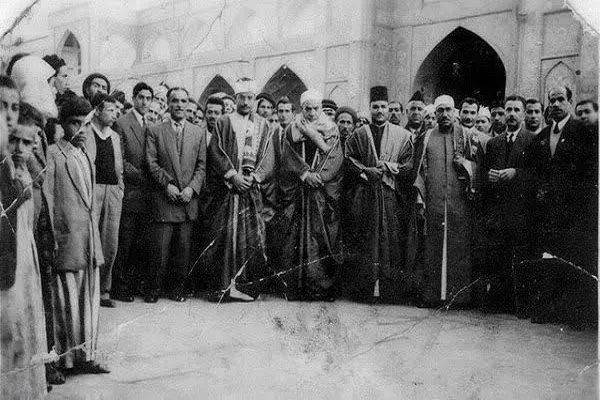

In the years when Iraq was at peace, a day came that changed the history of Quran recitation. The day when Abdul Basit Muhammad Abdul Samad, the inimitable legend of recitation, stepped into the luminous courtyard of the Shrine of Imam Musa Kadhim (AS) in Kadhimiya, Baghdad. That very moment, it was as if the sky of Kadhimiya held its breath to hear his voice.
The air of the shrine was filled with the scent of pilgrims’ perfume, the light of the lamps trembled on the shrine, and the whisper of pilgrimage echoed in the air. Suddenly, the crowd became a wave, all eyes turned in one direction; A young man with a calm face and a heavenly gaze entered. After paying his respects, Master Abdul Basit stood in front of the shrine, closed his eyes, and was silent for a moment; a silence that was the prelude to one of the most stormy recitations in history.
When the first verses flowed from his golden throat, the shrine was suddenly transformed. A warm, clear, unwavering, and heavenly voice… A recitation that was performed in 1956. His unique tone echoed in the air, and the echoes of the old courtyards made each verse a thousand times more lively. The pilgrims were crying uncontrollably, some had their hands on their chests, and some were sitting quietly on the ground, immersed in the recitation. It was as if this sound was descending not only into the ears, but also into the souls.
Abdul Basit’s recitation of verses 18 to the end of Surah Al-Hashr, Surah At-Takweer, and 27 to the end of Surah Fajr at the shrine of Imam Kadhim (AS) was not just an artistic performance. It was a spiritual encounter. The recitation took place in the presence of other Egyptian masters such as Abu al-Ainain Shuaisha and Abdul Fattah Shaasha’i, and next to the courtyard of Imam Musa Kadhim (AS) holy shrine.
Abdul Basit’s voice brought the images of the verses to life. Every rise and fall was like a breeze on the luminous sanctuary. Even the guards and servants of the shrine stopped moving at that moment; no one wanted to miss a second of this heavenly recitation.
It is said that on that day, Baghdad listened to his voice with respect. Pilgrims who had come from far and near later said the sound shook the hearts.
This historic recitation, beyond time and space, became a sign of the love for Ahl-ul-Bayt (AS) in the heart of the greatest reciter in the world; a love that the master himself had repeatedly mentioned. That day, he recited the verses as if he were sitting in the presence of angels.
Now, years later, on the anniversary of the passing of this unparalleled genius, that voice is still alive. Every time his recitation is broadcast in the shrine of Imam Kadhim (AS), it is as if the Baghdad of that year comes alive again and takes us on a journey among tears, longing, and heavenly verses.
Abdul Basit is gone, but his voice has become immortal in history. A voice that was forever engraved in the heart of the shrine of Imam Kadhim (AS).
Read More:
Abdul Basit Abdul Samad is known as one of the greatest Quran reciters in the world.
He was born in 1927 in the village of Al-Maza’iza, south of Egypt. His grandfather was a pious man, a Quran expert and a memorizer of the Quran.
At 10, Abdul Basit finished learning the entire Quran by heart in his village. He also learned 7 styles of Quran recitation by the age of 12 and the 10 styles by 14.
He started reciting the Quran in mosques and religious centers and soon became very popular.
In 1951, at the age of 19, he went to the capital Cairo for the first time and recited verses from the Quran at Magham Zeynab. Famous Quranic figures and reciters like Abdul Fattah Sha’shaie, Mustafa Esmaeel, Abdul-Azim Zaher, and Abolainain Shoaisha were present at the event. His performance was so outstanding that the crowd requested him to recite for longer than his allotted 10 minutes by his audience, and he continued to recite for over an hour and a half; his listeners were captured by his mastery of pitch, tone and the rules of Tajweed.
In the same year, he started reciting the Quran in Egypt’s national radio.
Abdul Basit travelled to many countries around the world for reciting the Quran. Once in Jakarta, Indonesia, over 250,000 people gathered in a mosque and streets around it to listen to his recitation.
In 1952 he made the Hajj pilgrimage and recited the Quran in the Masjid-al-Haram in Mecca and Masjid-un-Nabi in Medina.
Listening to his inspiring recitations of the Quran, many non-Muslims are said to have embraced Islam, including 6 in Los Angeles and 164 in Uganda.
Master Abdul Basit Abdul Samad died of diabetes and liver disease in November 1988. Thousands of his fans attended his funeral. The funeral was also attended by ambassadors of Islamic countries in Cairo.
4320214
