


Nahj Al-Balagha An Encyclopedia of Moral, Political, and Social Issues
IQNA – A memorizer of the Quran and Nahj al-Balagha from Afghanistan described Nahj al-Balagha as an encyclopedia of moral, political, and social Issues.
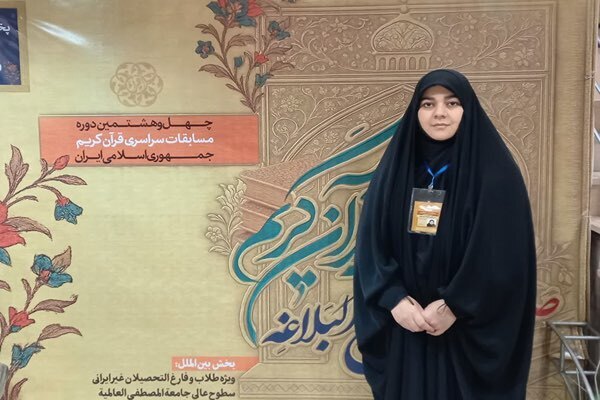
Samaneh Sadat Mousavi, who attended Iran’s 48th Quran competition in Sanandaj earlier this year, told IQNA in an interview that Nahj al-Balagha has useful tips in all areas and for all people.
“By referring to Nahj al-Balagha, we realize that these words are not the words of an ordinary person; rather, they are the words of a person with divine knowledge,” she stated.
Nahj al-Balagha is a collection of sermons, precepts, prayers, epistles and aphorisms of Imam Ali (AS) compiled by al-Sayyid al-Sharif al-Radi about one thousand years ago.
Mousavi added, “I am a memorizer of the entire Quran and in previous years I participated in the memorization of the entire Quran category, but this year I had the opportunity to participate in the field of Nahj al-Balagha, which was a good experience and I hope to repeat it in the coming years.”
Regarding the blessings of being familiar with Nahj al-Balagha, she said, “By being familiar with this book, I realized how true and very tangible the words of the elders who said Nahj al-Balagha is the brother of the Quran are because Imam Ali (AS) in his speeches and sermons, (gives advice about) all the daily events of society that people are involved with in their lives.”
Mousavi added, “In Nahj al-Balagha, the Commander of the Faithful (AS) has brought very precise and practical points in the political field regarding governance and leadership, covering up the faults of the people, and advising to take care of the people’s affairs. His sermons are very vivid in the field of family issues and relations. In these sermons, the Imam (AS) emphasizes putting aside differences and advises people to prioritize issues in life and to avoid sedition and fighting with each other.”
Read More:
She went on to say that in his sermons, Imam Ali (AS) expresses divine teachings for believers, political issues for politicians, and life tips for ordinary people. “In addition, he also explains the status of Ahl-ul-Bayt (AS) in detail so that people would know who they are relying on and also the personality of Ali ibn Abi Talib (AS). Therefore, by reading Nahj al-Balagha, we realize that these words are not the words of an ordinary person, but the words of a person with divine knowledge and the vision of God.”
Asked which part of Nahj al-Balagha was most attractive to her, Mousavi said the Shaqshaqiya sermon was most attractive. “In this sermon, the Imam (AS) says, ‘I remained silent while I had a thorn in my eye and a bone in my throat, and I suffered greatly from this patience.’ From the beginning, it was interesting for me to know the history of this sermon.”
4321276
