


UW Muslim Community Remains Resilient Despite Islamophobia
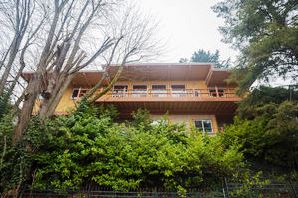
TEHRAN (IQNA) - Nestled among the fraternities and sororities of Greek row, a geometric orange house can been found. Purchased in 1979 by students, the house is now owned by the Muslim Student Association of UW (MSA) and is the University of Washington’s only mosque.
Referred to as the Islamic House (IH), the site is much more than a mosque for the Muslim community at the UW. It is a place for daily prayers, religious events such as Halaqas, Qur’an and Tajweed classes, and social events. The house is meant to be a safe and quiet place where students can not only work on their studies, but also build and strengthen their faith and create relationships with fellow Muslim students.
The IH, like many mosques, has recently been the target of misplaced anger and hatred. Many people negatively perceive mosques and associate them with radicalism, an association that has become more commonplace since the Paris attacks in November.
"It’s common for people to harass students outside the house,” said Varisha Khan, UW student and member of MSA.
Khan recalled an incident in which a man entered the house and began yelling at those inside. Upon leaving, the man picked up a brick and used it to break a window. Though the Seattle Police Department (SPD) was called, Khan and many others were not satisfied with their response.
"It took over an hour for them to arrive,” Khan said. "You hear about them responding to noise disturbances on Greek row quite fast, but it took them an hour to get to [the Islamic House]. There’s quite a contrast there.”
Khan went on to say the relationship between the SPD and the Muslim community needs strengthening, especially since harassment against Muslims has become increasingly common in recent months.
Just last month, 16-year-old Hamza Warsame fell from a rooftop to his death in Capitol Hill. Though there has been speculation his death was a hate crime, the SPD has not confirmed this.
Khan noted that the information from the SPD seems to be coming very slowly. She and other members of the community want the investigation to be taken seriously and handled well.
Whether or not Warsame’s death was a hate crime, many other Muslim lives have been lost due to Islamophobic rhetoric, much of which has been spread by prominent public figures and exacerbated by fears of more attacks similar to those in Paris.
In November Rep. Jay Rodne, R-Snoqualmie responded to President Barack Obama’s intent to welcome Syrian refugees with a Facebook post referring to Muslims as "barbarians” and stating that "Islam is incompatible with Western civilization.”
"This rhetoric is killing people,” said Amani Azzaidai, an officer for United Muslim Relief (UMR) at UW. "This has been going on for years, even before 9/11. It is a dehumanization and demonization of the Middle Eastern community.”
A study published by Harvard’s Belfer Center for Science and International Affairs in 2011 found that mosques and religiosity (among Muslim Americans) are actually associated with high levels of civic engagement and support for the American political system.
"The negative perception of Muslims in America is unfounded,” Khan stated. "As an American and a Muslim, I believe in freedom of religion and right to success equally, it’s written in our religion actually.”
Both Khan and Azzaidai said there are many misconceptions about Islam constantly circulating. A prominent one concerns Muslim women, who are often subjected to prejudice because of the way their faith is displayed. A hijab is easily recognizable and many interpret it as a way to oppress its women.
Contrary to popular belief, Azzaidai explained, many Muslim women voluntarily wear the hijab for their own religious beliefs. Furthermore, Muslim women are encouraged and expected to be educated, as one of the aspects of Islam is the expectation to excel in everything one does.
This aspect of the religion and Azzaidai’s own experiences with prejudice have been motivating for her.
"Being attacked in the media just makes us want to contribute more and to show that [Muslims] overwhelmingly support this country,” she said.
In difficult times like this, the IH remains a beloved space for members of the Muslim community at the UW.
"It’s nice to have a place to go and pray,” Azzaidai said.
Azzaidai and UMR also frequently use the space to organize and
hold events. UMR, a national nonprofit, does charity work built upon the
principle that all people, regardless of race or religion, should have a
sustainable livelihood.
Source: Daily UW
