


‘Imamate and Leadership’ Forum Held in Vienna
IQNA – A specialized meeting on “Imamate and Leadership: Historical-Theoretical Explanation of Leadership Continuity in Islamic Political Thought” was held in Vienna, Austria.
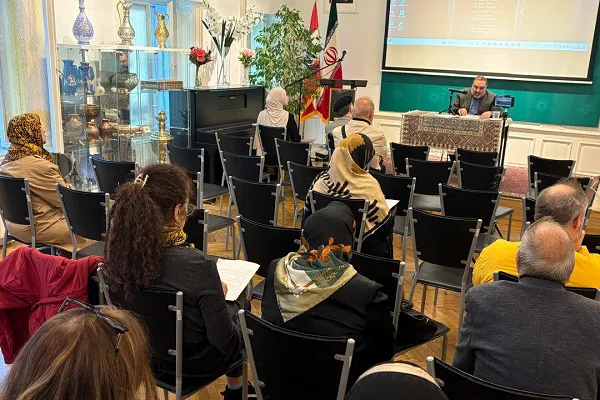
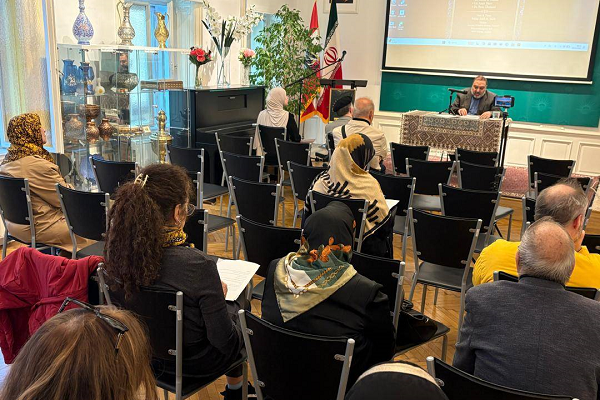
It was organized at the initiative of the Iranian Cultural Center in Austria at the Ibn Sina Hall of the Iranian Wisdom House.
According to the Public Relations Department of the Islamic Culture and Relations Organization (ICRO), this program, which was also held to commemorate the memory of martyred Leader of the Islamic Revolution Ayatollah Seyed Ali Khamenei, examined the historical and theoretical dimensions of the concept of leadership and imamate in Islamic political thought and emphasized the continuity of this concept in the history of Islamic thought.
In his speech, Professor Amir Hurr, a historian and university professor in Austria, outlined the characteristics, goals, and prospects of the modern Islamic civilization, and emphasized that Islamic civilization is not similar to an empire and never seeks to impose itself on others.
Rather, the axis of its growth and expansion in the world is the invitation based on rationality, dialogue, and freethinking, he said.
What is referred to as “Islamic civilization” can be analyzed from a theoretical perspective within the framework of two theories: the theory of the caliphate and the theory of the imamate, he stated.
In his opinion, apart from the Rashidun Caliphs, the subsequent caliphates - such as the Umayyad and Abbasid Caliphates - were not necessarily based on the Quran and the Prophet’s (PBUH) tradition and were mainly governed in the form of political systems with structures close to the empire.
But in the theory of Imamate, the fundamental principle is based on justice, spirituality, and human spiritual excellence, and from this perspective, politics and government should also serve the realization of justice and the spiritual advancement of humanity, Hurr said.
The historian added that governance systems began with simple and local structures, then expanded to empires, and in the modern era, they have taken the form of democracies.
According to him, this trend shows that humanity is on the path of evolving governance methods, but it is still facing serious crises at the global level.
Read More:
He went on to say that in the current situation, we need to rethink the concept of governance so that it can be formulated in the form of the idea of “global governance” and inspired by the concept of Imamate.
Professor Salim Ahmad Hadizic, as the second speaker, explained the importance of continuing the guidance of Muslims after the passing of the Holy Prophet (PBUH), and discussed various views on the issue of caliphate and succession in the Islamic world.
Hadizic said it is very important for Muslims to consider themselves committed to the Holy Quran, the Sunnah of the Prophet (PBUH) and his Ahl-ul-Bayt (AS) and to organize their individual and social lives accordingly.
Elsewhere in his remarks, he praised the personality of the martyr Ayatollah Seyed Ali Khamenei and emphasized that hHe played a great and unique role in enlightening the Islamic world and helping the oppressed, especially in the Islamic world.
Hadizic considered his presence at the meeting a moral duty and said, “I am a Bosnian living in Austria, and for me, one of the highlights of the leadership of the martyr Ayatollah Khamenei was when he called everyone to help my people in Bosnia.”
Referring to the deep sympathy of Ayatollah Khamenei for the people of Bosnia during the Bosnian war (1992), he said that the martyred Leader repeatedly mentioned the importance of supporting the people of Bosnia against aggression in his Friday prayer sermons and continuously emphasized this support.
Hadizic emphasized that it is a religious and moral duty to appreciate martyr Ayatollah Khamenei’s services to the Bosnian nation, which made him a unique role model.
Reza Gholami, the Iranian Cultural Attaché in Austria and Head of the Iranian Wisdom House, in his speech titled “Leadership and Succession in Abrahamic Religions; A Comparative Study between Christianity and Islam,” offered an in-depth and comparative study of the theological foundations of leadership theories and showed that this issue remains one of the most vital religious and political questions in the contemporary world.
He compared the two great Abrahamic traditions by posing the fundamental questions of “Where does leadership originate, what gives it legitimacy, and how is it transmitted from one generation to another.”
The Iranian House of Wisdom in Vienna, as a center for cultural, philosophical, and scientific dialogue between Iranian-Islamic tradition and contemporary thought, hosted this event, which was well received by researchers and those interested in Islamic and Iranian studies.
4349066
