


Massachusetts Mosque Invites Public to Learn Shared History of Muslims
IQNA – For one afternoon, a home in South Dartmouth, US state of Massachusetts, that doubles as a mosque became a classroom.c
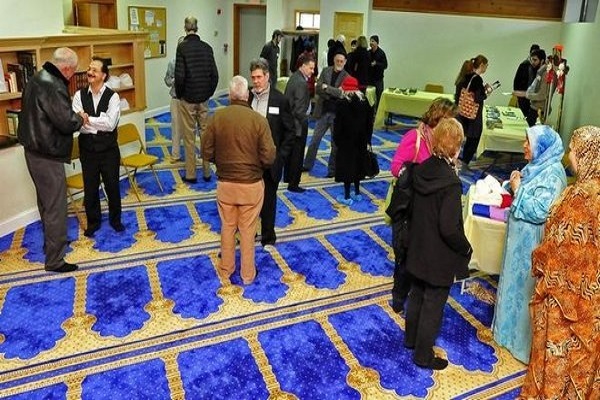
This past weekend, visitors filtered into a beige-brick house blended into a South Dartmouth neighborhood. It looked like any other house, except for a sign outside that read “Masjid Al Ehsan,” the mosque of the Islamic Society of Southeastern Massachusetts.
Some women wore colorful scarves with sequins, while others had bouncy bob cuts; some men came in ankle-length robes and knitted kufis, others in cargo pants and baseball caps. They left their shoes in the wooden cubbies by the door and brought with them a handful of questions about the Islamic faith.
At Masjid Al Ehsan, about 50 people attended “Open Mosque Day,” joining a monthlong national initiative in which mosques invite the public to visit, tour and learn about Islam under the theme, “One Nation Under God.”
Backed by the Council on American-Islamic Relations (CAIR) and the US Council of Muslim Organizations (USCMO), the initiative is designed to build bridges, answer visitors’ questions and address common misconceptions about Islam and Muslim communities.
“We want to show how familiar we are,” said Martin Bentz, the outreach coordinator for the Islamic Society of Southeastern Massachusetts, which the mosque is part of. “Our hope is to make it clear that Muslims aren’t some kind of strange, esoteric group, hidden behind mosque walls or engaged in anything arcane.”
The event also marked a return. Organizers held similar open mosque days in 2017, 2018 and 2019, until the pandemic brought them to a halt.
“Building relationships with all faith communities is important,” said Andrew O’Leary, superintendent of New Bedford Public Schools, who attended the event. “Sometimes I am the teacher and the superintendent, but today I am a student.”
To meet that curiosity, Bentz organized two panels. The “Muslims in America” panel dug into the history of Muslims in the United States and added less-known facts, and the “What is Sharia Law” panel explained the body of religious guidance that governs Muslims’ conduct and ritual practices.
Panelists described Sharia as the divine guidance Muslims follow to live moral lives and grow closer to God, shaping religious practice and everyday matters including business, contracts and social issues.
The panel, which included Bentz and the mosque’s imam, Saad Meer, also spent much of the time challenging the ways that some Republicans in Congress have described Sharia.
In December 2025, U.S. Reps. Keith Self and Chip Roy of Texas founded the Sharia-Free America Caucus, which now includes about 60 members from 25 states. The caucus argues that Sharia is incompatible with the American way of life and a threat to the Constitution. Its members have introduced several bills in the past two years.
One bill introduced in October 2025, the “Preserving a Sharia-Free America Act” seeks to deny visas, benefits or immigration relief to people who adhere to Sharia, and it could lead to removal or deportation for those who fail to disclose that adherence.
“To us this is shocking,” said Bentz. “It means we can’t pray, we can’t fast, we can’t give charity, and more.”
In February, the CAIR announced that it had designated the House group an anti-Muslim hate organization.
Bentz said the anti-Sharia caucus is pushing a false narrative by raising alarms about the law taking over the country or being imposed on Americans, even though Muslims make up about 1% of the US population.
“We’re not going to take over anything and we’re not going to impose anything on anyone,” said Bentz. “But we want to show that we’re not a threat at all because we represent the same humane principles as any of the faiths.”
Read More:
The panel took questions from the audience.
“Muslims, as part of their practice, are bound to respect the civil laws of the country that they reside in,” Bentz said. “So they cannot actually do something that would be in violation of a constitutional law.”
The panel on the history of “The Muslims in America” challenged a common assumption — that Islam only recently arrived in the United States. Bentz traced its presence to the 1600s.
The first significant waves of Muslims in North America came through the slave trade. Historians estimate that 10% to 50% of the roughly 10 million Africans brought here against their will were Muslim, though enslavement often stripped them of the ability to practice their faith openly.
“Many people even claim Muslims have never been part of American law or the Constitution,” said Bentz.
Source: newbedfordlight.org
