


Forum Discusses Historical Course of Egypt Quran Recitation
IQNA – The Library of Alexandria held a forum entitled “Quran Recitation in Egypt; A Study of Its Flourishing and Decline” as part of the cultural program of its International Book Fair.
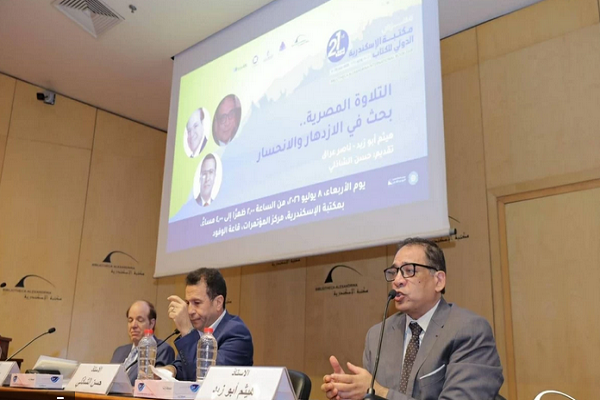
The forum was attended by Haitham Abu Zayd, a researcher and historian, and Nasser Iraq, a writer, with Hassan Al-Shazly, a presenter and speaker, chairing the session.
The main focus of the forum was the book “Quran Recitation in Egypt; A Narrative of Its Shine and Paths of Decline” by Haitham Abu Zayd. This work narrates the history of the Egyptian recitation school and, while examining the causes of its flourishing and the factors affecting its decline, explains the position of this art as one of the prominent pillars of Egypt’s cultural and artistic identity.
Hassan Al-Shazly said this book, by examining the evolution of Quran recitation in Egypt, addresses an important aspect of Egyptian identity.
He added that Egyptian reciters, through their distinctive performance styles and adherence to technical principles and Quranic positions, established a pioneering school whose influence spread throughout the world.
Haitham Abu Zayd also explained that this book is the result of 38 years of listening to and researching the art of Quran recitation, and is compiled in 323 pages, two parts, and 10 chapters.
He added that the first part deals with the evolution of the Holy Quran in Egypt from its arrival at the time of the Arab conquests to the printing of the first written version of the Quran to the pivotal role of the Egyptian Radio.
Abu Zayd stated that the Egyptian Radio, since its establishment in 1934, has contributed greatly to the formation of the golden age of recitation and its global expansion by utilizing a precise mechanism for selecting and classifying reciters.
He emphasized that prominent figures of this era include Sheikh Muhammad Rifaat, Abdel Fattah Shaasha'i and Mustafa Ismail, and that Sheikh Abdul Basit Abdul Samad became a global phenomenon and was considered one of the key instruments of Egypt's soft power by traveling to more than a hundred countries.
Abu Zaid added that the second part of the book deals with the reasons for the decline of the Egyptian school of Quran recitation. He explained that this transformation began in the mid-1950s, accelerated with the advent of cassette tapes, and was finally intensified with the emergence of digital platforms that allowed direct dissemination without regard to traditional technical standards of recitation.
Nasser Iraq, an author and novelist, also emphasized that Quran recitation in Egypt is not simply a religious art, but is an inseparable part of the identity and cultural memory of the Egyptian people.
He added that this book provides valuable documentation on the cultural, artistic and political history of recitation in Egypt and examines its evolution over the decades.
Read More:
He called for the book to be taught in technical criticism centers as well as in the faculties of literature, medicine, and engineering, because he believes that this work not only narrates the history of recitation in Egypt, but also documents various aspects of Egypt’s cultural, intellectual, political, and musical history.
The forum ended by emphasizing that the style of Quran recitation in Egypt is a comprehensive artistic school based on mastery of Tajweed (the rules of recitation), skillful performance based on “musical maqams,” and systematic improvisation; characteristics that have made this style one of the prominent pillars of Egypt’s cultural identity and one of the main pillars of the country’s soft power.
The 21st edition of the International Book Fair of the Library of Alexandria began on July 6, 2026 and will continue until July 20, 2026.
4363627
