

Kuwaiti Qari’s Stances Contradict Essence of Divine Teachings: Iraqi Quranic Figure

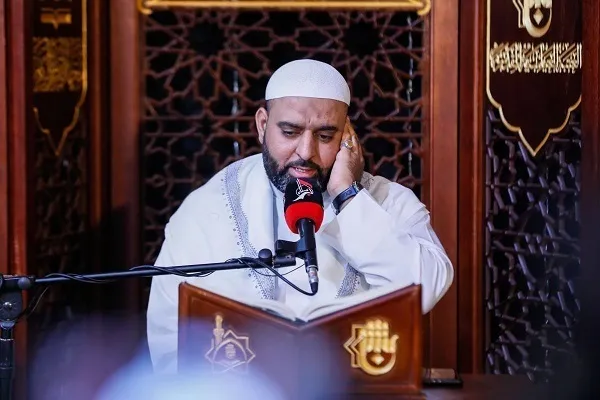
The owner of a beautiful voice is not exempt from accountability and responsibility when he becomes part of a discourse that attacks the oppressed or remains silent about the aggressors, Karbalayi told IQNA in an interview, which is as follows:
IQNA: To what extent are Mishary al-Afasi’s recent positions consistent with the famous hadith that “there may be reciters of the Quran who are cursed by the Quran”?
Karbalayi: When a famous reciter of the Quran aligns himself with a political discourse that justifies American-Zionist aggression, or attacks an Islamic group known for its anti-colonial stance, this presents us with a deeply dangerous example of this hadith.
The Quran is not simply a set of words to be recited, but a moral project and a civilizational stance. A Quran that calls for support for the oppressed and the rejection of oppression cannot be compatible with a discourse that provides moral cover for those who commit murder, siege, and aggression against the people of the region. Therefore, the real danger lies in using the Quran as a tool in a discourse that contradicts its essence.
IQNA: What is the impact of Al-Afasi’s negative thoughts and beliefs on public opinion in the Muslim world?
Karbalayi: The danger of Al-Afasi lies in the fact that he is not just an ordinary reciter, but a figure with a wide audience in the Muslim world. This gives his words an impact that goes beyond the personal sphere. When such positions, which originate from a Salafi-Wahhabi background that is historically known for taking a hostile stance against Ahl-ul-Bayt (AS), are disseminated, they contribute to reproducing a divisive discourse in Muslim society.
Read More:
For some, this leads them to equate piety with hostility towards the axis of resistance or with hostility towards anyone who opposes the American and Zionist project. This is a serious danger, because the masses may sometimes be deceived by the beauty of the recitation, assuming that someone with a beautiful voice necessarily has a correct understanding of the Quran. Indeed, while a person’s voice may be attractive; their intellectual compass may be skewed.
IQNA: What is the duty of Quranic activists, reciters, and memorizers in the Islamic world regarding this deviation?
Karbalayi: The first duty is to make it clear that the Quran is not limited to mere recitation and that a true reciter of the Quran is someone whose stance on issues facing the Muslim community is shaped by the verses of the Quran. The Quranic community cannot remain silent when the Quranic fame of an individual becomes a platform for justifying aggression or attacks on forces that have paid a heavy price in defending the independence of the Ummah. In addition, it is necessary to provide insightful Quranic models that combine beautiful recitation with doctrinal and moral awareness so that the listener is not captivated by sounds without understanding. Protecting Quranic teachings today is a great responsibility, because deviation from the truth, if it is by a prominent figure, can have a more severe impact than political deviation by ordinary individuals.
IQNA: Do you agree with the removal of this reciter’s recitations from radio and television channels, media and social networks? And what is the responsibility of the media in this regard?
Karbalayi: When a reciter uses his widespread presence and fame in the Islamic world to promote positions that serve biased political discourse against the core issues of the Muslim community, it is natural for media institutions to reconsider the nature of his presence. Because Quranic media are not simply platforms for transmitting voices, but are also responsible for directing public awareness. This is not a personal issue, but a moral and cultural responsibility.
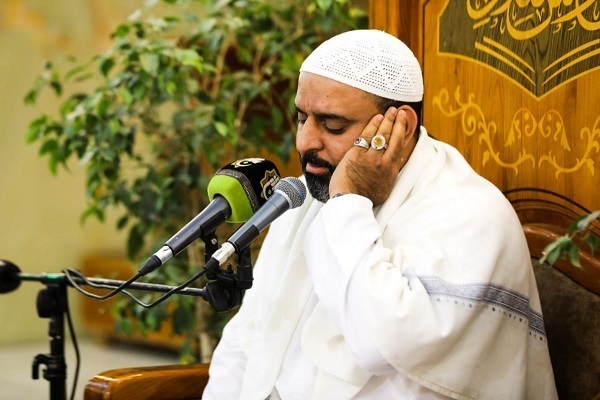
The audience must understand that the owner of a beautiful voice is not exempt from accountability and responsibility when he becomes part of a discourse that attacks the oppressed or remains silent about the aggressors. It is the duty of activists in the online sphere to expose this contradiction consciously and calmly, not with emotional reactions.
IQNA: Why does someone like al-Afasi, who is known for his beautiful voice, take such positions?
Karbalayi: Having a beautiful voice does not necessarily equate to depth of insight or a balanced stance. Beliefs and political backgrounds shape many choices and thoughts. When someone is influenced by an intellectual environment that sees the axis of resistance as a greater enemy than the occupiers, it is natural to gravitate towards rhetoric that attacks Iran and aligns with regimes that avoid direct confrontation with the American and Zionist project. Thus, we see their positions being harsh towards the axis of resistance, in contrast to their extreme weakness or blatant silence regarding the killing, siege and destruction that has occurred and continues in Gaza, Yemen, Iraq and Iran.
Read More:
IQNA: What is the reaction to this Kuwaiti reciter’s opinion among the general public and Quranic activists in Iraq?
Karbalayi: In Iraq, especially among knowledgeable Quranic circles close to the school of Ahl-ul-Bayt (AS), there is a clear understanding that these positions are not new, but rather the continuation of a well-known intellectual trend. Therefore, many reciters and activists have treated them not as mere political opinions, but as manifestations of a doctrinal orientation that sees the axis of resistance as a stubborn enemy. Iraq, which has paid a heavy price in the fight against terrorism and is aware of the sacrifices made to protect the region, cannot easily accept rhetoric that attacks forces that have resisted projects of domination and division.
IQNA: What should we do to benefit from the pure knowledge of the Quran and avoid deviation?
Karbalayi: What is needed is to rebuild our relationship with the Quran based on thought, understanding, and commitment, not just on a beautiful voice. The Ummah needs a reciter who lives the Quran before reciting it and makes its verses the standard of action, not one who just has an impressive voice. We must educate generations who understand that the Quran links recitation with justice, memorization with insight, and beauty of voice with moral perfection, because the most dangerous deviation is to raise the voice of the Quran while its individual essence is devoid of practical manifestation.
4348463
