


Role of Russian Orientalist Movement in Development of Quran Translation
IQNA – Some believe that Russians’ interest in translating the Quran has no historical roots and arose solely as a result of the collapse of the Soviet Union.
However, history emphasizes that Muslims have always been interested in copying and translating the Quran, and this is also true about Russian Muslims.
Also Russian orientalists have made a significant contribution to the translation of this Holy Book.
According to the Islamic Center for Strategic Studies affiliated with the Astan (custodianship) of Hazrat Abbas (AS) holy shrine, it can be said that the translation of the Holy Quran is an independent science with its own rules and principles. This requires that the translator be honest, reliable, and have extensive knowledge of at least two languages (the source language and the target language). The translator must also be familiar with other languages and related disciplines so that he can benefit from them by comparing his work with other translations.
When translating the Holy Quran, the translator must be familiar with Quranic sciences and hadith, and have constant contact with religious scholars of different schools and consult with them. The translator is also obliged to be fully aware of the errors in past translations in order to avoid their repetition.
Today, most studies in Quranic sciences in Russia are strongly influenced by orientalist traditions, and the educational and missionary activities of Muslim scholars force orientalists to focus on hadith and historical texts, sometimes avoiding incomplete interpretations of the Quran. These translations have found considerable acceptance among Russian-speaking Muslim communities who are eager to understand the meanings of Quranic words.
A translation of the Holy Quran into Russian was carried out by Dr. Somayeh Afifi, Professor of Russian Language in the Department of Slavic Languages at the Faculty of Languages of Ain Shams University in Cairo, Egypt. She began the translation in 1995 and completed it in 2000 under the supervision of a committee from Al-Azhar. The translation was well received by Russian-speaking Muslims who were eager to understand the meanings of the Holy Quran.
Emergence of Russian orientalist movement and its role in development of Quran translation
Russian is one of the languages of the world into which the Holy Quran has been translated. The development of the stages of translating the Holy Quran into Russian has been associated with the development of the stages of Russian orientalism. Islam and Muslims have played a large and important role in the history of Russia.
The beginning of Russian orientalism can be attributed to the reigns of Peter the Great and Catherine the Great, who witnessed the beginning of a real interest in Arab culture.
Read More:
During this period, Arabic, along with French, English and German, was included as one of the main languages of Russia. This happened in the first quarter of the 18th century, during the reign of Peter the Great (1725 AD), whose reign witnessed fundamental reforms and steps that had a significant impact on the future of Russia and its reconstruction.
Historical sources indicate that a full century after the emergence of the Russian principalities in the second half of the 10th century AD, this new state began to search for a religion among the heavenly religions.
Prince Vladimir requested that the kings and princes of several countries send envoys to inform him of their religions so that he and the other Russian princes could choose one of these religions as the official religion of the state, with the aim of further unification and strengthening the legitimacy of their rule.
The Russians and Eastern Savvi were familiar with the main tenets of these religions and had constant contact with the Jewish Khazars, as well as with the principles of Orthodox Christianity in Byzantium and Catholicism among their western neighbors.
The Russians had also become acquainted with some of the teachings of the Islamic religion, and had heard about a book called the Quran from the Muslim Bulgars living in the lands along the Volga River (present-day Tatarstan).
Interest in Oriental studies in Russia grew from the beginning of the 19th century. At that time, several Russian universities, including Kazan University, Moscow State University, Saint Petersburg University, and Lazarev College, established Arabic language courses. Various Russian governments also encouraged the study of the Arab-Islamic heritage, especially that of the Muslim-populated regions under Russian control, in order to broaden the knowledge of the Muslim people.
The formal study of Arab-Islamic Oriental studies began during the reign of Peter the Great, and the first translation of the Holy Quran into Russian was completed in 1716. This translation was made by Dr. Pyotr Postenkov, from a French translation of the Quran made by the French orientalist Durey in 1643.
However, the first direct translation of the Quran from Arabic into Russian was made in 1878 by Sablukov (1854–1880), who was fluent in Arabic. This translation was reprinted several times from 1879 to 1898.
Mukhlinsky (1808-1877), an Arab scholar, also translated the Quran into Belarusian and Polish for the Muslim Tatars living in Belarus, Poland, and Lithuania.
In 1778, Arabic script was widely introduced into Russian printing houses. In the same year, the Holy Quran was printed in beautiful Arabic script in St. Petersburg, the capital of Russia.
The Holy Quran was reprinted in Arabic script several times between 1789 and 1798, and it is worth noting that it later played an important role in the Kazan Islamic Publishing House, which was founded in 1802. During the 19th century, tens of thousands of copies of the Quran and a large number of Islamic works were printed by this publishing house.
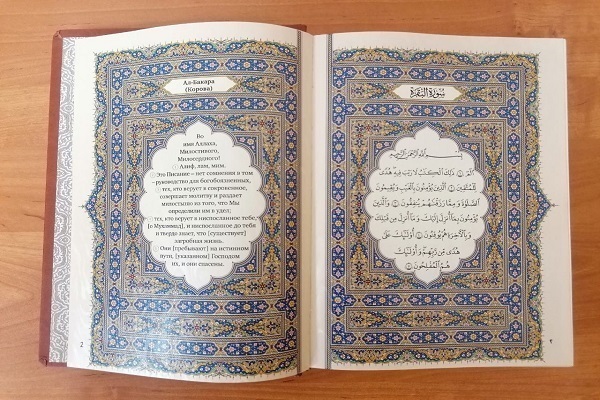
At that time, two translations of the Holy Quran into Russian, taken from French and English, were printed and published. The first translation was made by Verivukin in 1790 from the old French translation by "Du Royer" and the second in 1792 from the English translation by "Kolmakov". These two translations were of a good standard compared to the previous translations.
One of these two translations later inspired Pushkin, the famous Russian poet, who adapted it to compose his famous poems and used 33 Surahs of the Quran in these poems. The Russian poet admitted that "the Quran is the first religious book that amazed my mind."
Pushkin was very successful in presenting a precise picture of philosophical and religious concepts in his poems. These poems became the key to the correct understanding of the Holy Quran for the first time in Russian literature and contributed greatly to the continuation of the interest in the Holy Quran among Russian society.
Read More:
Pushkin was not interested in Islam and the Holy Quran out of a vacuum or fantasy; Rather, it was the fruit of his in-depth study of the history, civilization, and literary and Quranic works of the Arabs and the roots of the Islamic religion.
Translation was one of the most important bridges of communication in Russian Orientalism, and the translation of the concepts of the Holy Quran had a prominent place among Russian translations. The early translations of the Quran were carried out through European intermediary languages. After a while, following the teaching of Arabic to Russian translators, it became possible to translate the concepts of the Quran from Arabic to Russian. Therefore, the Holy Quran became a vital factor in understanding the relations between Russia and the Islamic world.
Krachkovsky (1883-1951), a famous Russian orientalist whose name shone brightly in Russia in the first half of the 20th century, made many efforts in the field of education and scientific research in the field of Orientalism, and his works are distinguished from other books due to their impartiality and fairness in portraying the Holy Prophet (PBUH), the religion of Islam, and the Holy Quran.
Krachkovsky has reflected the image of the contemporary East with an official, religious, and personal interest in Eastern literature and culture.
In 1859, his book was published under the title "Complete Index of the Quran or an Introduction to its Words and Phrases". This book is a guide to the study of the religious, legal, historical and literary principles of the Holy Quran. However, one of the shortcomings of this book is that it does not rely on the text of the Holy Quran but on the Mushaf of the German orientalist Gustav Flugel.
In 1864, the Russian translator Nikolaev supervised the translation of the concepts of the Quran taken from the French translation by Bieberstein Kazmirsky. Nikolaev's translation was reprinted five times in Moscow and was reprinted in 2001 by Alborclassics.
Some critics have criticized the poor state of the translation, especially when we see that there is no general common ground between the translation criteria.
Many Russian specialists and orientalists have criticized the Russian translation of the concepts of the Quran by Sablukov. In his book "History of Islam", Krymsky noted that Sablukov's translation is a literal and dead translation and in many cases cannot be understood except by referring to the Arabic original. In addition, this translation contains undeniable errors.
Despite these shortcomings, Sablukov's translation has met the needs of many Russian Muslims for more than a century and is considered one of the most important sources on Islam.
Sablukov published other works of his translation in 1879, followed by two articles entitled "Information on the Holy Quran" in 1884. He also published an article entitled "Comparison of the Beautiful Names of God in Islam and Christianity" in 1873.
The last translation made from an intermediary language was Nikolaev's translation. Then Russian Arabists began to translate directly from the Quran. In this regard, two translations were made almost simultaneously: the first by General D. N. Jugoslavsky graduated in Arabic studies at the University of St. Petersburg in 1871 and worked for many years as a translator for the Russian embassy in Istanbul.
At the beginning of the 20th century, the Ukrainian scholar Krymsky published a translation of several Surahs of the Quran with their commentary. However, he did not complete his project.
After the collapse of the Soviet Union, the interest in translating the Quran increased significantly, especially among the former Soviet republics.
In conclusion, the Holy Quran has continued to amaze Westerners, both Arabists and Orientalists, due to the profound transformation it has brought about in Arab and Islamic societies and the vitality and dynamism it has given to human civilizations. They have diligently studied this divine book and carefully examined its texts. As a result, Orientalist studies of the Quran have become popular in academic circles.
4324381
