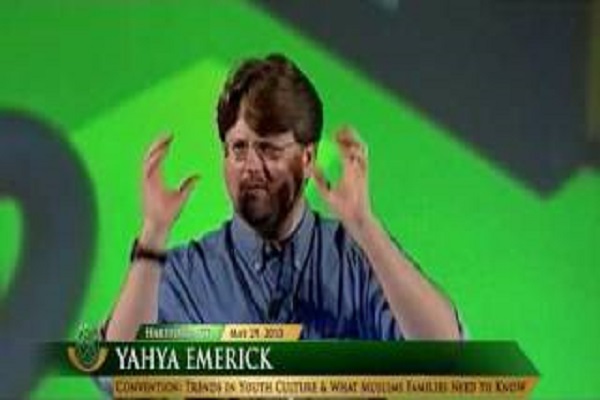
Although not widely known outside Muslim circles, his books from children’s fiction to Quran explainers became staples in English‑language Islamic learning.
Emerick, born in 1971 into an Irish‑American Baptist family, converted to Islam after struggling with Christian theology and spending months studying the Quran in university. As he once recalled, “I couldn’t deny the personal appeal from God to the reader.”
He entered the world of Islamic writing with a frustration over existing English‑language material. “A lot of Islamic books were written in a very one‑dimensional way without much verve or imagination,” he said, explaining his desire to portray Islam as “a blend of spiritual, emotional, intellectual and practical things all woven together in an artistic tapestry.”
His Ahmad and Layla Deen stories were among the earliest Muslim‑centered fiction for young readers in the US. He argued that such literature was essential for identity formation: “If our kids spend their reading time reading only about non‑Muslims and their world, then our Muslim kids will feel that the non‑Muslim world is the ‘real’ world.”
Beyond fiction, Emerick authored numerous educational works, including a popular installment of the Complete Idiot’s Guide series. He frequently warned that Muslim families in secular societies must actively teach faith to their own children: “Muslims take it for granted that a kid from a Muslim family will stay Muslim by osmosis… We have to do da’wah to our own children.”
Working two jobs and largely self‑publishing through Amirah Publishing, Emerick also founded the Islamic Foundation of North America bookstore and engaged in interfaith activism.
Former students remembered him as approachable and patient. Fawzia Syed, who first met him in middle school, wrote that she was “never too intimidated to ask him questions… He was an authority figure, but I felt like I could ask him anything.”
In one of his final reflections, Emerick urged Muslims to prepare future generations with relevant, imaginative tools: “Future generations will either have an easier time being Muslim or a harder time based on our groundwork today… That’s a big responsibility.”
He often signed his books with a simple motto: “Thinking long term.”
Source: MuslimMatters


