


Al-Azhar Emphasizes Integrity of Quranic Text
IQNA – The Al-Azhar Islamic Research Council held the third session of the series of ‘Doubts and Answers’ meetings.
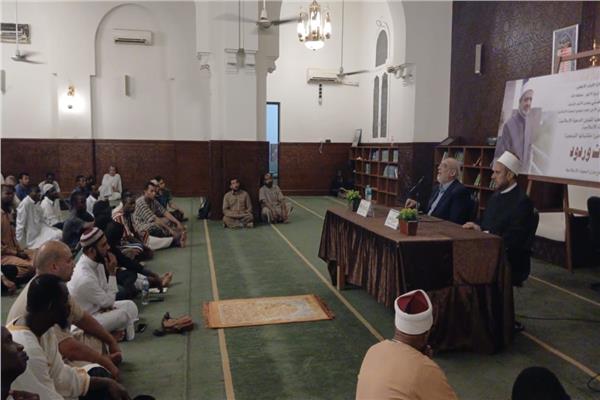
The meeting addressed the topic of collecting the Quran and responding to misconceptions about it.
It rejected claims that verses of the Quran were lost or that unauthorized texts were added to it during the process of collecting and writing the Quran in early Islam.
The session was attended by Sami Abdel Fattah Hilal, former head of the Tanta Quran Faculty, and Hassan Yahya, deputy secretary general of the Supreme Committee for Propagation Affairs at the Al-Azhar Islamic Research Council.
In his speech at the event, Sami Abdul Fattah Hilal emphasized that misconceptions about the compilation of the Quran, often propagated by some Western writings, focus on claims of ambiguity in the history of the Quran and the delay in its compilation, which are not based on reliable historical facts.
He explained that some orientalists claim that the verses were not written under the supervision of the Holy Prophet (PBUH) and that the compilation was done after his death but these claims ignore the role of the scribes of revelation who recorded the Quranic verses as they were revealed.
Hilal emphasized that the Holy Quran has been preserved both in the hearts of the believers and in writing, and this guarantees the accuracy and authenticity of its text.
The compilation of the Quran during the caliphate of Abu Bakr was a response to an urgent need after the martyrdom of a number of Quran reciters, he said, adding that the Quran was compiled in authentic manuscripts based on what was written during the lifetime of the Holy Prophet (PBUH) and what was preserved in the hearts of the companions, a process that has been emphasized in authentic historical narrations.
Read More:
Hilal also pointed out the role of the angel Gabriel in the revelation of the Quran to the Prophet (PBUH) and said the Quran that exists today exactly corresponds to the final version and the text revealed in the last stage of the revelation of the verses to the Prophet (PBUH) by Gabriel.
He went on to emphasize that the standardization of the writing of the Quran during the caliphate of Uthman ibn Affan was carried out with the aim of preserving the unity of the Muslim community, and these copies were transcribed from the original pages that were with Hafsa, one of the wives of the Prophet (PBUH).
Hassan Yahya, for his part, emphasized that the authentic Hadiths about the compilation of the Quran show a high level of accuracy and attention, and that the companions did not rely solely on memory; rather, they adapted the written texts to what was preserved in the hearts of the people.
He explained that the collection of the Quran during the Uthman era was done to maintain Muslim unity and prevent differences in recitation, stating that this action helped to standardize the written versions of the Quran and was not done to “correct defects” in the Quranic text itself as some claim.
He emphasized that the claims regarding the loss of parts of the Quran are unsubstantiated.
The history of the Quran reveals a comprehensive system of memorization and transcription, and emphasizes the need to refer to reliable sources to distinguish between established facts and misconceptions, he added.
4369176
