


Bosnian Women with Both Academic, Quranic Achievements
IQNA – A group of young Muslim women at the University of Sarajevo’s Faculty of Medicine have become a symbol of the connection between religious identity and academic excellence.
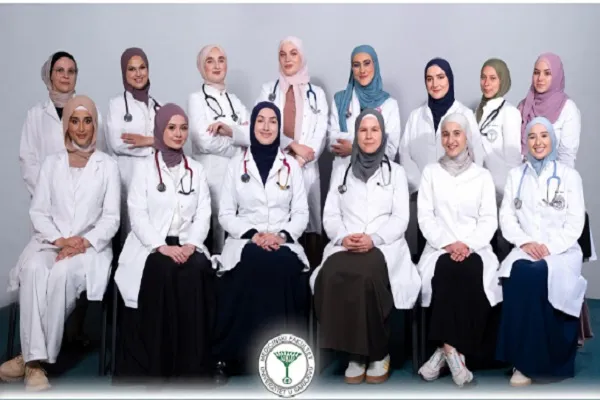
They have won brilliant academic honors alongside outstanding achievements in memorizing the Holy Quran.
According to the muslimsaroundtheworld website, in Muslim societies, identity is inseparable from an individual’s academic and professional path; in fact, it can be a source of stability, order, and responsibility. When Islamic identity is combined with specialized education and academic excellence, examples emerge that show that preserving religion and culture does not hinder the pursuit of knowledge, but can be an integral part of a successful and productive academic and professional personality.
In this context, a group of young Muslim women at the Faculty of Medicine of the University of Sarajevo have achieved outstanding academic results. Among them are medical graduates, students continuing their studies, and recipients of academic awards and honors.
They include Quran memorizers Edina Serdrejović, Asija Mivić, and Khadija Cengić, along with Fatima Gavran Kaptanović-Ismail Begović, who initiated the group through her academic position at the Faculty of Medicine.
Edina Serdrejović graduated on July 15 of this year. Since elementary school, she has dreamed of becoming a surgeon. She sees medicine not just as a profession, but as a calling to serve humanity, and the most important motivation for completing her rigorous studies is the benefit that a doctor can bring to others.
Quran memorizer Khadija Cengić did not intend to study medicine since childhood. After completing her studies at Islamic high school, she pursued this field, choosing a career that was directly related to serving humanity.
She had memorized the Quran before enrolling in medical school, and she considers the memorization experience to be a very important preparation, as it instilled in her discipline, patience, perseverance, and a sense of responsibility.
Cengić emphasizes that motivation may drive a person to begin their journey, but it is discipline that helps them persevere when studying becomes difficult. She notes that knowledge is a trust that should be used to serve humanity.
Asija Mjević graduated from medical school with a GPA of 9.24 and received the University of Sarajevo Silver Medal, reflecting her passion for medicine and the intricacies of the human body.
At the beginning of her studies, she had concerns about adapting to her identity as a veiled Bosnian Muslim woman, a medical student, and a future researcher. However, her university experience reinforced in her the belief that true standing in academia is built on knowledge, work, professionalism, and excellent interpersonal skills.
Mivić believes that the fact that several hijab-wearing girls from her generation have received university silver medals is a recognition of their knowledge, hard work, and academic excellence.
Read More:
The hijab is part of their identity, not a substitute for competence. The experiences of these young women show that the hijab is a manifestation of their Islamic identity.
Sardarijević says that the hijab has not been an obstacle during her academic journey, but has made her feel more responsible for her work methods and interactions with others, and a greater commitment to ensuring that her knowledge and professionalism are trustworthy.
Mivić emphasizes that hijab-wearing Muslim women can share their knowledge, efforts, and values in a variety of fields.
University professor Fatima Gavran Kapitanovic believes that these students combine pride in their faith with a desire to become doctors who serve people with knowledge and humanity. She noted the presence of silver medalists, a Quran reciter, and several students with outstanding academic results.
At the same time, she emphasizes that academic and professional standards in the medical school are the same for everyone, and that male and female students are judged on their knowledge, work, responsibility, and character. The white coat, she adds, imposes clear requirements of competence, compassion, humanity, and dedication to patient care.
These experiences provide a broader picture of the success of veiled female medical students. They are examples of young Muslim women who have preserved their identity and made the hijab an integral part of their presence, while simultaneously walking a difficult scientific path, achieving excellence, and pursuing professional aspirations in surgery, scientific research, and patient care.
Herein lies the most important value of this experience: that Islamic identity, science, expertise, and professional success can coexist in one person, and that preserving identity does not hinder excellence. Rather, it can be a driving force for assuming greater responsibility for science, humanity, and society.
4368982
