

Connecting Religion, Community at Islamic Center of Vila Cahón in Brazil

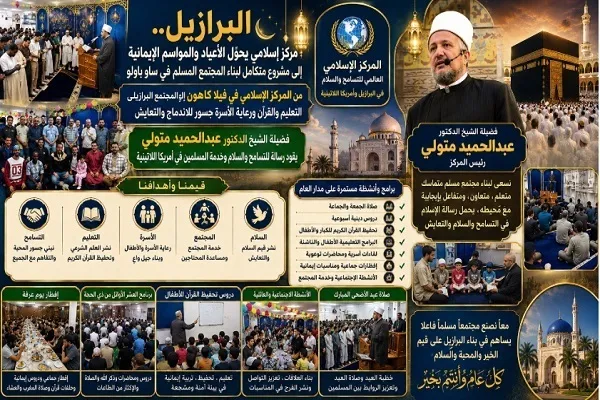
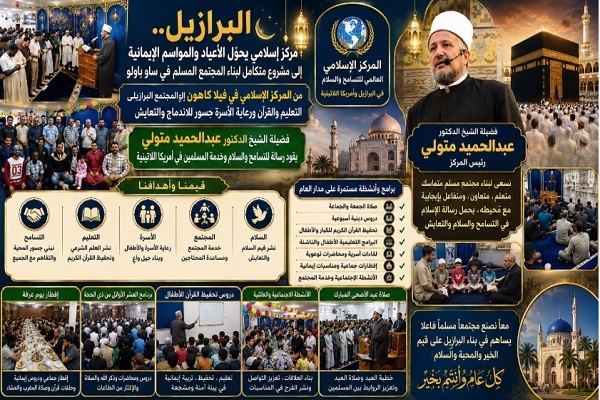
In a scene that reflects the dynamism of the Muslim community in São Paulo, Brazil’s largest city, the Islamic Center of Vila Cahón continues to play a role beyond religious rituals, as it has become a comprehensive platform for education, family relations, social services, and the promotion of tolerance and coexistence, according to the Muslimsaroundtheworld website.
The diverse activities organized by the center in the past few months demonstrate a practical model of an Islamic institution that seamlessly combines worship, education, and social participation.
The importance of this experience lies in its role as a model for Islamic institutions operating in countries with Muslim minorities. This helps preserve Islamic identity, provide an educational and nurturing environment for new generations, and strengthen connections between Muslims from diverse cultural and ethnic backgrounds in Brazilian society.
Religious festivals and occasions
During Eid al-Adha, the center hosted Eid prayers and a religious sermon delivered by Sheikh Dr. Abdulhamid Mutawalli, president of the International Islamic Center for Tolerance and Peace in Brazil and Latin America. His sermon focused on the values of sacrifice, obedience, tolerance, unity of hearts, and service to those in need.
Read More:
The occasion was not limited to performing religious rituals. It also became an opportunity to strengthen social bonds between worshipers, families, and children. This demonstrates the growing social role of Islamic institutions in Brazil and their ability to transform religious occasions into unifying events that strengthen belonging, identity, and solidarity.
Teaching the Holy Quran
The activities organized by the center show a clear focus on memorizing the Holy Quran and teaching Islamic sciences through memorization circles, regular lessons, and educational programs aimed at children and adolescents.
The center also hosted special events during the first ten days of Dhul Hajjah, including religious lessons, introductory lectures, and religious gatherings aimed at deepening religious awareness, connecting members of the Muslim community with important Islamic occasions, and reinforcing Islamic values in daily life.
One of the most prominent aspects reflected in the center’s programs is its focus on the family as the cornerstone of building a Muslim society. Educational programs were dedicated to children, alongside family gatherings and social activities that brought parents and children together in a safe and stimulating environment to learn and get to know each other.
This approach helps to strengthen the connection of new generations with their religion and culture and to preserve Islamic identity in a multicultural and multilingual society like Brazil, where the importance of educational and religious institutions in transmitting values and knowledge to new generations is increasing.
The center also organized a mass iftar on the Day of Arafah, which was attended by a large number of Muslim families. The iftar included Quran recitation sessions, religious lessons, and Maghrib and Isha prayers.
These events demonstrate the importance of religious occasions in strengthening the spirit of solidarity and mutual understanding among members of the Muslim community and in consolidating the concept of the Islamic center as an inclusive space for worship, education, social work, and service to different segments of society.
The activities and programs organized by the center emphasize that the message of tolerance and peace is the main focus of its work. The center strives to present a positive image of Islam and promote the values of mutual respect and coexistence among the different components of society.
This message is particularly important in Brazil, one of the most culturally and ethnically diverse countries in the world. This diversity makes dialogue and understanding between different communities essential to building a cohesive society characterized by mutual respect and cooperation.
Located in eastern South America, Brazil is the largest country on the continent in terms of area and population, with over 210 million people. The Muslim population of Brazil, including citizens and residents, is estimated at over one million. A significant portion of this population lives in São Paulo, the main center of Islamic life in the country and home to numerous mosques and Islamic educational and cultural institutions.
4355542
