


Iranian, Iraqi Scholars Meeting in Baghdad Stresses Muslim Unity
IQNA – A meeting of Sunni and Shia scholars from Iran and Iraq was held in the Iraqi capital of Baghdad on Friday.
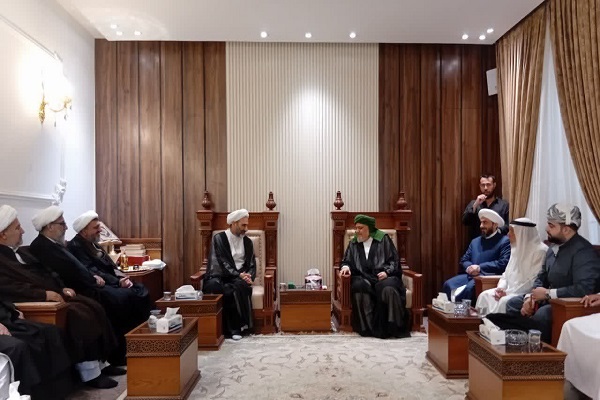
It was organized after the Friday prayers at the al-Quds Grand Mosque in Baghdad.
Speakers at the meeting emphasized the significance of Islamic solidarity with the axis of Husseini thought against the oppressors of the world.
Sayed Abdul Qadir Alusi, the head of the Jamiat Ulema of Ribat Muhammadi in Iraq, in his speech emphasized the unity of Islamic scholars from all countries, and said, “Our intellectual foundations and the movement of Islamic thinkers and scholars must be based on the axis of unity and solidarity, and this is more necessary than anything in today's conditions of the Islamic world.”
He added, “We have one Quran, one Prophet, one Qibla, so what should be the first priority on the agenda of the scholars of Iraq, Iran, Lebanon, Egypt and all countries and all schools of thought from Hanbali and Shafi'i and all segments of the Kurds, Turkmen and others is solidarity and resistance against the enemies of Islam.”
Read More:
This Sunni scholar stated that if the Islamic solidarity, emphasized by the Quran and the Holy Prophet (peace be upon him), is weakened, the oppressive powers will turn to weakening Islam and will damage the essence of resistance in the Islamic world and will weaken the Islamic Ummah.
He went on to say that the resistance has always revolved around an important pole throughout history and in the contemporary era, and the leaders and commanders of the Islamic resistance, from Abu Mahdi al-Muhandis to Seyed Hassan Nasrallah, from Martyr Soleimani to the martyred Leader of the Islamic Revolution, all moved around this pivot in their movements, which is the personality and movement of Imam Hussein (AS).
Ayatollah Ahmad Molabghi, a member of Iran’s Assembly of Experts, was another speaker at the meeting.
He said the unity of the Umamah is the basis for the realization of the unity of worship.
Ayatollah Molabghi added that according to the Holy Quran, the Islamic Ummah is not simply a mental concept or an abstract ideal; Rather, it is a social and historical truth.
“The Quran also does not stop unity at a lower level. The unity of a tribe, the unity of a religion, the unity of a group or a movement, although it may be valuable in its own right, is not the ultimate horizon of the Quran.”
He added that the Quran wants unity to be a characteristic of the entire Ummah, not a characteristic of a part of the Ummah against another part.
He emphasized that the nation either has unity and as a result is powerful, or it is caught in the whirlpool of conflict and slowly loses its existential capital.
4366010
