


Memory of Martyred Leader Gives Arbaeen Procession A New Meaning: Spokesman
IQNA – Iran's Foreign Ministry spokesperson said this year's Arbaeen has taken on a different atmosphere in light of recent regional developments and the martyrdom of a number of Iranians.
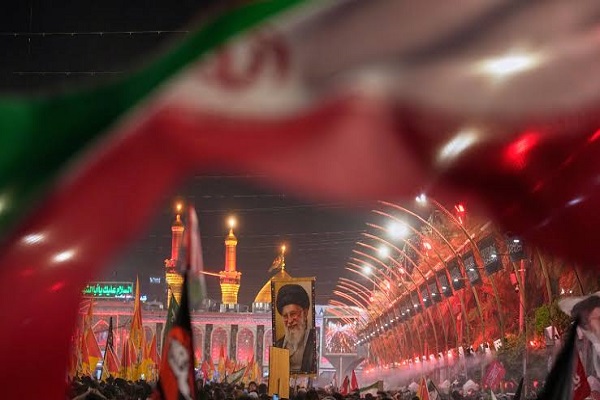
Speaking to Radio Arbaeen, Esmaeil Baghaei said that every Iranian pilgrim participating in the Arbaeen walk will carry with them the memory of Iran's martyrs, particularly the martyred Leader of the Islamic Revolution.
He said Arbaeen has always been significant for Iranians, for Shiites, for all freedom-seeking people around the world, and for everyone who values human dignity, honor, and nobility.
"However, this year's Arbaeen has one major distinction: the first pilgrim to Karbala was our martyred Leader. As you may recall, Iraqis themselves welcomed our martyred Leader with this title, and banners reading 'Welcome to the First Arbaeen Pilgrim' were displayed in various parts of Iraq," he said.
Baghaei said that the current atmosphere evokes, for Iranians and all Shiites, the events of the year 61 AH, as steadfastness against oppression, perseverance on the path of truth, and the pursuit of dignity have once again been demonstrated.
Referring to recent developments, the Foreign Ministry spokesperson said that this year's U.S. and Israeli military aggression, and the attack carried out by "the most wicked individuals against God's finest servants," marked a turning point in the history of Shiite Islam and Islam as a whole.
"I have no doubt that every Iranian traveling to Arbaeen this year will remember, with every step toward the shrine of Imam Hussein (PBUH), the martyred Leader, our distinguished figures, and all those who sacrificed their lives in defense of Iran's dignity," he said.
Wishing success and safety for Arbaeen pilgrims, Baghaei added: "I humbly ask all pilgrims to pray for us and congratulate those who have been blessed with the opportunity to undertake this spiritual journey. Undoubtedly, throughout the Arbaeen march, pilgrims will keep alive the memory of the children, the martyrs of Minab, Lamerd, and every one of Iran's martyrs, while remaining grateful for the sacrifices made for Iran's dignity and honor."
Iran's Missions in Iraq Ready Around the Clock to Serve Arbaeen Pilgrims
Baghaei said the Foreign Ministry, in cooperation with other relevant authorities, has taken all necessary measures to provide services along the Arbaeen pilgrimage route. Consular services will be available in major pilgrimage cities, including Karbala, Najaf, Samarra, and Kadhimayn.
He added that a significant number of additional personnel have been dispatched to provide consular and other essential services for the large-scale pilgrimage. In addition to Iran's consulates in Karbala and Najaf, several temporary consular service offices have been established. Temporary offices have also been set up in cities such as Kadhimayn, Samarra, and Hillah, where Iran does not normally maintain consulates.
The Foreign Ministry spokesperson said all consulates and service centers are operating 24 hours a day, and Iranian nationals can contact the dedicated 128 hotline for assistance, consultations, and consular services. He also noted that internet facilities along the pilgrimage route and the launch of the Sajjad online system have significantly facilitated border crossings, while expressing appreciation for the efforts of Iran's Law Enforcement Command.
He stressed that all these arrangements have been made through close cooperation between the foreign ministries of Iran and Iraq, with consulates and temporary offices operating around the clock to assist pilgrims.
Attack on Shalamcheh Targets Iranians' National and Religious Values
Responding to a question about the recent U.S. strike on border areas, including Shalamcheh, Baghaei said that a journalist had raised a similar question during his weekly press briefing, asking about the significance of attacking the Shalamcheh border crossing, a key route for Arbaeen pilgrims.
He noted that during U.S.-imposed war, Iranian citizens and senior national figures were martyred, while the country's infrastructure also suffered damage.
Baghaei said that over the past two weeks, the opposing side has adopted a new pattern of military aggression against Iran by deliberately targeting civilian infrastructure in an apparent attempt to inflict suffering on ordinary Iranians.
"What military value is there in destroying a bridge in a town or village, other than causing hardship for the Iranian people wherever they may be?" he asked.
He said the attack on the Shalamcheh border area was similar to last week's strike on a bridge along the Tehran-Mashhad highway and argued that these incidents were not accidental.
"They have targeted not only military and civilian infrastructure, but also values that are sacred to the Iranian people—from the pilgrimage route to Imam Reza's shrine to the Arbaeen walking route. This demonstrates that the United States has a problem with our authentic Iranian and Islamic values," he said.
The Foreign Ministry spokesperson stressed that such actions are strictly prohibited under international law, are condemnable, and constitute war crimes. He added that they also reveal the U.S. leadership's attitude toward the Iranian people, Iran as a country, and Iranian-Islamic values.
U.S. Hostility Toward Iran Predates the Past Four Decades
Responding to a question about recent remarks by the U.S. secretary of state Marco Rubio regarding Iran, Baghaei said such statements are nothing new.
He argued that U.S. hostility toward Iran should not be viewed as limited to the past four decades, but rather dates back to the 1953 coup, when the United States and the United Kingdom collaborated to overthrow Iran's government.
He continued that this pattern was repeated through Washington's full support for Saddam Hussein during the Iran-Iraq War, including assistance that enabled Iraq to acquire chemical weapons as well as the downing of an Iranian passenger aircraft and the imposition of what even U.S. officials have acknowledged were unprecedented sanctions.
"None of these measures, however, has succeeded in preventing the Iranian nation from pursuing its dignity and independence," he said.
Baghaei added that the insults and offensive remarks heard today from U.S. officials are signs of desperation.
"Abusive language and insults are never signs of strength; rather, they reflect weakness and helplessness in the face of the determination, resilience, and steadfastness of the Iranian people," he said.
Arbaeen Strengthens the Iranian Nation's Pursuit of Dignity
In the final part of his remarks, Baghaei addressed the Iranian people and Arbaeen pilgrims, saying: "We must recognize what we have achieved, who we are, and take pride in ourselves."
He said Iran's ability to defend its dignity and independence despite what he described as the enemy's overwhelming and ruthless appearance could be understood from two perspectives.
"First, the Iranian nation is deeply rooted. We are rooted in our land, our history, and our civilization. Our national and Islamic values are an immensely valuable asset that has come to our aid during these days," he said.
Referring to a narration attributed to Imam Ali (PBUH), Baghaei said that people reveal their true character in times of hardship, and the same principle applies to societies.
"Iranian society, the Iranian nation, and Iranian civilization have shown the world their true nature under these difficult circumstances. That nature is nothing other than nobility, commitment to the path they have chosen, and the pursuit of dignity and independence," he said.
He expressed confidence that, through reliance on God and appreciation of the nation's valuable assets, Iran would thwart all hostile plots.
Highlighting the spiritual significance of the Arbaeen pilgrimage, Baghaei concluded that the Arbaeen march is far more than a ceremony; it carries a profound message.
"Arbaeen is about preserving the ideals of Karbala and Imam Hussein (PBUH), which are fundamentally the ideals of dignity. It teaches that whenever a person must choose between dignity and humiliation, dignity must prevail, because God created human beings with honor."
Source: Radio Arbaeen
