


Kosovo’s Historic Mosques Are Part of Its Cultural Memory, Islamic Community Official Writes
IQNA – Historic mosques in Kosovo should be viewed as an integral part of the country’s cultural and historical heritage rather than solely as places of worship, an official said.
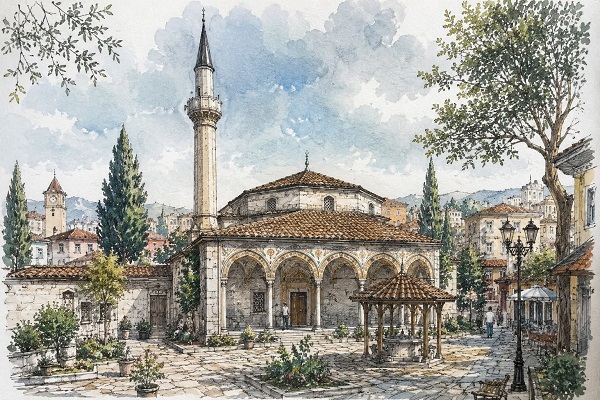
Ramadan Shkodra, head of the Publication and Culture Department at the Presidency of the Islamic Community of Kosovo, made the remark in a new commentary.
In his article, Shkodra argues that Kosovo’s mosques are important material evidence of the country’s social, architectural and cultural development. He says their history is closely linked to the institution of waqf, or Islamic endowments, which for centuries supported religious, educational, social and public institutions.
According to Shkodra, Kosovo’s cultural heritage has been shaped by the interaction of different civilizations, cultures and traditions, with Islamic heritage representing an important historical layer that developed over more than five centuries.
He writes that mosques are particularly significant because they combine architectural, artistic and historical elements and reflect both Islamic traditions and local Albanian craftsmanship. Many, he adds, were established or supported by Albanian benefactors, nobles and philanthropists, making them evidence not only of religious life but also of a longstanding Albanian tradition of charitable endowment.
Shkodra argues that the role of mosques historically extended beyond worship. They served as centers of education and community life and were connected to broader developments in urban planning, culture, social organization and economic activity.
The author also discusses what he describes as the marginalization of Islamic heritage during parts of Kosovo’s modern history. He argues that some historical narratives influenced by Serbian historiography portrayed Islamic monuments as foreign or imposed elements rather than as part of Kosovo’s historical development.
He further writes that, during the socialist period in the former Yugoslavia, a number of mosques and other Islamic institutions were damaged or demolished, sometimes under the justification of urban modernization or state policies.
According to Shkodra, the destruction of Islamic heritage reached another level during the Kosovo War in 1998 and 1999. He states that 218 mosques were attacked, damaged or destroyed during the conflict, while religious schools, tekkes, endowment properties, libraries and historical archives were also targeted.
Shkodra characterizes the destruction as an attack not only on religious buildings but also on the historical and cultural memory of Kosovo’s Albanian population. He argues that the loss of these monuments impoverished Kosovo’s cultural heritage as a whole.
The author also calls for greater academic documentation, professional restoration and institutional recognition of the country’s Islamic heritage. He points to recent initiatives by Kosovo’s Ministry of Culture to restore and preserve several mosques of particular archaeological and architectural value as a positive development.
Shkodra highlights the exhibition “Memory in Images – Destroyed Mosques in Bosnia and Herzegovina and Kosovo During the 1990s: Planned Religious Genocide,” held in Pristina on December 18, 2025, as an example of efforts to document destroyed religious heritage.
He notes that papers presented at the opening of the exhibition were subsequently published in Edukata islame, allowing the material to move beyond a visual exhibition and into academic and documentary work.
For Shkodra, preserving historic mosques also means preserving the history of the endowment system that helped build and sustain them. He argues that safeguarding this heritage requires preserving not only the buildings themselves, but also their documents, stories, functions and links to the communities that established and used them.
He concludes that restoring the historical standing of Kosovo’s mosques and Islamic endowments should not be understood simply as a return to the past. Rather, he presents it as an effort to recover an important part of Kosovo’s cultural memory and incorporate it into the country’s contemporary historical and cultural understanding.
Source: Muslimsaroundtheworld
