


Mecca Museum Showcases Rare Quranic Manuscripts, Including 19th-Century Copy
IQNA – A rare copy of the Quran from 1843 is now on display at Mecca’s Holy Quran Museum, part of a special collection of historic manuscripts opened to the public in the Hira Cultural District.
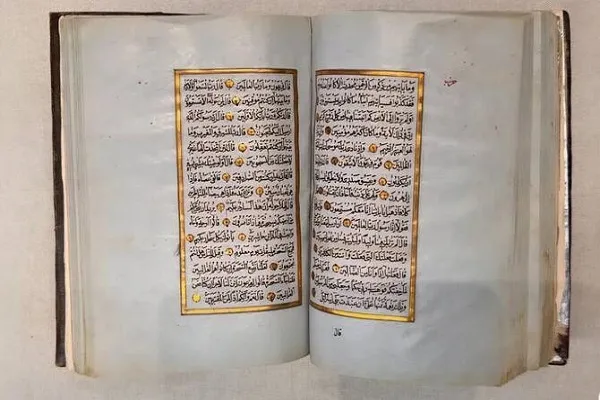
The manuscript is distinguished by its meticulous hand in black ink, fully vocalized, with pages bordered by a gilded frame and gold rosettes parting one verse from the next, alongside finely wrought floral motifs that speak to how far the art of gilding and adorning Quranic copies had advanced by that period.
It also reveals a particular attention to the Quran’s textual divisions: its pages bear the markers of the ajza’ (parts) and aḥzab (sections), a reflection of how scribes and scholars sought to make recitation, review, and memorization easier, without surrendering the codex’s aesthetic and artistic refinement.
According to the information displayed alongside it, the Quran was later restored and rebound to shield it from the wear of time, a step that has prolonged the life of this rare Quranic artifact and kept it standing as a witness to a cultural and civilizational legacy now reaching back more than a century and a half.
It is displayed as part of the museum’s collection of historical exhibits, where visitors and pilgrims can trace the history of the Quran’s transcription, copying, and ornamentation across successive Islamic eras through a collection of historical manuscripts and rare printed editions.
Read More:
The museum has emerged as one of Mecca’s leading cultural and intellectual destinations, illuminating the historical labors Muslims have undertaken in the service of the Quran and its preservation, and deepening public awareness of the Islamic heritage bound to the holy book through modern displays and interactive educational experiences that enrich the visit and strengthen the visitor’s connection to the history of the sacred text.
Source: Arab News
