


Scholar Traces Three Stages of Mourning for Imam Hussein in Early Islamic History
IQNA – A Lebanese researcher offered a historical analysis examining how mourning rituals for Imam Hussein (AS) and the martyrs of Karbala evolved during the first five centuries of the Islamic Hijri calendar, identifying three distinct phases from personal grief to public ritual.
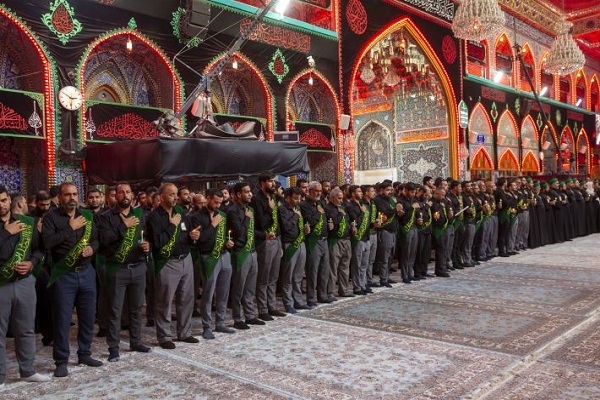
Lebanese author, translator, and researcher Haidar Hobbollah has published a detailed study on the history and dimensions of mourning for Imam Hussein (AS) on his research website, hobbollah.com. The analysis examines how Muslims mourned following the martyrdom of the grandson of Prophet Muhammad (PBUH) in the Battle of Karbala in 680 CE.
Three Stages of Mourning
According to Hobbollah’s research, mourning rituals for Imam Hussein (AS) and the Karbala martyrs can be divided into three stages over the first five centuries of Islam:
Stage One: Personal, Non-Institutionalized Mourning
Stage Two: Mourning as a Limited Religious Practice
Stage Three: Mourning as a Social Phenomenon, Public Ritual, and Political Act
Grief as a Natural Response
Hobbollah argues that mourning for Imam Hussein (AS) initially reflected a natural human response to tragedy. He writes, “Even if there had been no religious significance associated with mourning rituals for Imam Hussein (AS), it would have been natural for people to weep for him and for those martyred alongside him during that period.”
Historical sources indicate that the year of Imam Hussein’s martyrdom (61 AH / 680 CE) became known as the “Year of Sorrow”. Hobbollah cites Muwaffaq al-Khwarazmi (d. 568 AH), who quoted historian al-Bayhaqi as stating that the year in which Imam Hussein (AS) was killed, year sixty-one, was named the Year of Sorrow.
Read More:
The phrase ‘Year of Sorrow’ suggests that grief for Hussein (AS) became a widespread phenomenon, not limited to a few individuals.
Early Mourning Practices
Hobbollah documents several early examples of mourning, including accounts recorded by Ibn Tawus (a 7th-century AH Shia scholar) describing the immediate aftermath of the battle. The account describes women emerging from tents barefoot and weeping, asking to be taken to the site where Imam Hussein (AS) was martyred.
Read More:
“I will never forget Zaynab (SA), daughter of Ali (AS),” the account continues, describing her lamenting for Hussein (AS) with a sorrowful voice. Hobbollah notes that this represents a natural mourning gathering, distinct from contemporary organized ceremonies, and cautions that such accounts do not necessarily prove that early generations considered these practices a formal religious ritual.
Distinction between Lamentation and Self-Flagellation
The research makes an important linguistic distinction: “Lamentation is a verbal act, while striking the face is a physical act.” Hobbollah notes that when Zaynab (SA) lamented for Hussein (SA), it did not necessarily mean she struck her face. This distinction applies to all historical texts that describe lamentation rituals.
First Organized Mourning Gatherings
Hobbollah identifies Umm Salama, a wife of the Holy Prophet (PBUH) as one of the first women to hold a mourning gathering for Imam Hussein (AS) in Medina. Mourning continued among the people of Medina, the Banu Hashim clan, and the Prophet’s (PBUH) household for more than a year. Some historical accounts indicate they wore black mourning clothes.

The researcher also documents the mourning rituals of the Tawwabin (the Penitents) who rose up in 65 AH / 685 CE. According to historian al-Tabari, they visited Imam Hussein’s (AS) grave at dawn and remained there for a day and a night, praying and seeking forgiveness. “The people cried out and wept together,” al-Tabari records. “There was no day with more weeping and wailing than that day.”
Transition to Public Ritual
The research tracks how mourning for Imam Hussein (AS) gradually transformed from private expression into organized public commemoration. This transition was significantly influenced by the rise of Shia dynasties, particularly the Buyids (Al-e Buyeh), who ruled from 322-448 AH / 933-1056 CE.
Under Buyid rule, mourning ceremonies expanded from private homes into streets and marketplaces, eventually becoming a distinctive symbol of Shia identity.
4358676
