


Unity Civilizational Strategy of Martyred Imam for Islamic Ummah: Bahraini Cleric
IQNA – A senior Bahraini cleric said that unity from the perspective of martyred Leader of the Islamic Revolution Ayatollah Seyed Ali Khamenei is not just a slogan; rather, it is the main keyword in his civilizational strategy to restore dignity and authority to the Islamic Ummah.
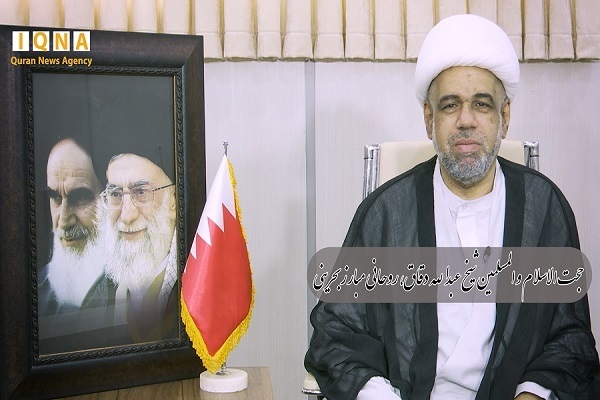
In an interview with IQNA, Sheikh Abdullah Daqqaq highlighted different aspects of the martyred Leader’s approach to Muslim unity.
He said the martyred Imam considered Islamic unity to be a religious obligation and a strategic and civilizational necessity for the Islamic Ummah, not merely a political slogan or a short-term tactic.
“He emphasized that the enemies of Islam target the Islamic Ummah as a single entity and do not differentiate between different Islamic sects; therefore, confronting political, military, and cultural challenges is possible only through the unity of Muslims, their solidarity on the axis of fundamental commonalities, and the avoidance of differences, and this will strengthen the capabilities of the Islamic Ummah.”
He added that Ayatollah Khamenei considered the following to be the main obstacles to Islamic rapprochement and unity:
a) Religious fanaticism and sectarian exclusivism; He considered this issue one of the most important internal obstacles to Islamic unity and said: ‘There is an internal obstacle to unity, and that is religious bigotry. This bigotry exists among all religions and must be eliminated.’
He emphasized that adherence to a sect’s beliefs is legitimate, but the problem begins when defending the sect turns into hostility towards other sects or insulting their sanctities.
b) Stirring up religious and historical differences in the public arena; He distinguished between scientific research and inciting public sentiment.
c) Arrogant and colonialist projects that are pursued with the aim of dividing and dividing the Islamic Ummah. Among his famous statements was: ‘The enemies of the Islamic Ummah want to create a distance between Iran and the Islamic world, as well as between Muslims.’
d) Takfiri and extremist movements; Ayatollah Khamenei considered takfir to be the most dangerous tool for dividing the Islamic Ummah and said in this regard: ‘Takfiri movements in practice serve the goals of arrogant powers, colonial governments, and the Zionist regime, even though they operate under the cover of Islam.’
e) Ignorance of the common interests of the Islamic Ummah and preoccupation with minor and marginal conflicts.
The fight against religious division and sedition had a central place in Ayatollah Khamenei’s speeches and messages. He repeatedly emphasized that fueling sectarian conflicts is one of the most dangerous projects targeting the Islamic world and that preserving the unity of the Ummah is one of the most important religious and political tasks of the present era.
He always emphasized that unity does not mean unifying the sects or eliminating their doctrinal and jurisprudential characteristics, but rather means agreeing on the supreme interests of the Islamic Ummah and working together to defend them.
Imam Khamenei believed that the dignity, independence, and scientific, political, and economic progress of the Islamic Ummah depend on its unity and cohesion, and that religious division leads to a waste of capacities and weakens the ability to confront external challenges; while unity provides the opportunity to utilize the great capacities of Muslim nations on the path of movement and progress.
Read More:
Asked about the measures the martyred Leader took to achieve the proximity of Islamic schools of thought, Sheikh Daqqaq said:
The following are among the most important measures and strategies that Imam Khamenei supported or emphasized:
- Supporting scientific dialogue and meetings between scholars of Islamic religions.
- Strengthening the activities of the World Forum for Proximity of Islamic Schools of Thought.
- Continuously emphasizing the ban on insulting the symbols and sanctities of Islamic schools of thought.
- Revival of the “Islamic Unity Week” as an opportunity to strengthen convergence among Muslims.
- Focusing on the common issues of the Islamic Ummah, especially the issue of Palestine.
Sheikh Daqqaq was also asked about the role of scholars and religious elites in achieving the proximity of Islamic schools of thought. He said:
Martyr Ayatollah Khamenei believed that scholars and religious elites have a great responsibility in this regard, and this responsibility is realized through the following:
- Promoting a culture of mutual respect among followers of religions.
- Avoiding provocative speech and behavior that causes sedition.
- Emphasizing common beliefs, jurisprudence, and civilization.
- Raising awareness among the people about the danger of Western and Zionist projects that seek to divide and disintegrate the Islamic Ummah.
- Expanding scientific and cultural ties between different religious institutions.
Asked whether he remembers any examples of respect for followers of different Islamic schools of thought in the life and teachings of the martyred leader, the Bahraini cleric said:
Yes, on various occasions, Ayatollah Khamenei has emphasized the need to respect all Islamic sects and has taken well-known positions on the prohibition of insulting the personalities and sanctities of Muslims, which causes sedition between Shias and Sunnis.
He also constantly emphasized the need to manage religious differences within the framework of Islamic brotherhood, coexistence, and mutual respect. In addition, he met with Sunni scholars and always emphasized the most important issue of the Islamic world, the issue of Palestine. Despite the fact that the majority of Palestinians are Sunnis, his actions showed that he respected all followers of Islamic sects.
4362943
