


Catholic Scholar: Lady Fatima Is a ‘Model for All Human Beings of Integrity’
IQNA – A prominent Catholic theologian and Islamic studies scholar highlights Lady Fatima (SA) as a timeless beacon of truth, transcending religious boundaries.
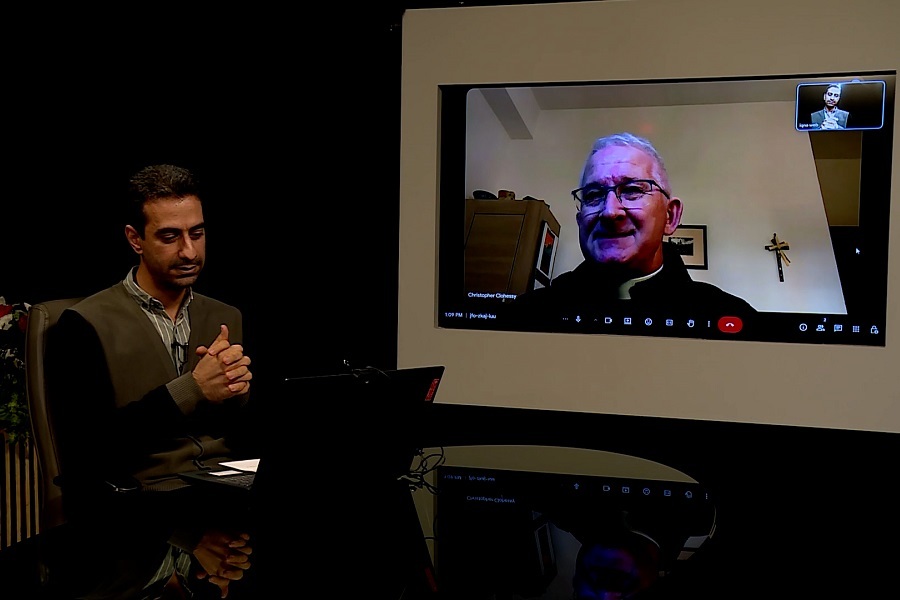
Christopher Clohessy, who has dedicated years to studying the life of holy Muslim figures, including Lady Fatima (SA), through early Arabic sources, argues that her legacy is defined by an unwavering moral standing.
Speaking to IQNA, when asked how he would introduce her to a non-Muslim audience, Clohessy offered a profound observation on her universal relevance amidst the challenges of the modern world:
"I would suggest that she is a model for human beings, not just Muslims, but all human beings of integrity. I think integrity is the virtue that is most absent in the world today. We have an enormous amount of fake news and falsehood. I think that Lady Fatima's life was underpinned and accentuated by an integrity," he said.
Clohessy is a South African Catholic priest and Senior Lecturer at the Pontifical Institute for Arabic and Islamic Studies (PISAI) in Rome.
Bringing an academic yet respectful outsider’s perspective to Islamic history, his doctoral research culminated in the book Fatima, Daughter of Muhammad (Gorgias Press). The work offers a rigorous study of her historical and theological significance, analyzing her role through both Sunni and Shia traditions.
What follows is the full text of IQNA’s conversation with Clohessy.
IQNA: You are a Catholic Priest who wrote one of the detailed academic works on Lady Fatima (SA). What drew you personally and spiritually to her story?
Clohessy: Well, I was doing a doctorate here in Rome in the Vatican University for Arabic and Islamic studies, and I was really going to do a doctorate on Al Hussein [AS], trying to write as a Christian theologian, an understanding of the Christian theology that echoes in some of Al Hussein's own theology. And of course, reading about Lady Fatima, his mother, I was quite shocked to discover that there was almost nothing written about her, at least nothing academic. There were lots of pamphlets in Farsi and in Arabic, praising her virtues, hagiography, but an academic work based on the primary sources, the Arabic sources, was lacking.
So I decided to change direction, I put aside Al Hussein, although only for a while, and I wrote my doctorate as an academic presentation to a Western audience of Lady Fatima based on the earliest Arabic sources that we have, both Sunni and Shi'i, and so produced what I think was the first real biography, now there are others. And this was some years ago. This was in the early 2000s.
IQNA: And if you were to revisit the topic today, with what you have learned during all these years, is there anything you would revise, expand, or reframe about your portrayal of Lady Fatima?
Clohessy: I will expand a great deal because, again, I was a young scholar. My Arabic is much better now than it was in those days. I have far more access to the sources than I did in those days. Back in those days, we didn't have the ease of the internet by which you could access Arabic texts.
I would certainly include a great deal more of her life and her virtue. I took a number of incidents that I thought important as a beginning, as an introductory measure, but I think that now I almost certainly will write a second volume, Lady Fatima, including a whole other incidents in her life and important words about her that I did not include in the first.
I've also rethought a number of issues about her, and my thoughts have developed about how I reacted at first to issues like Fadak, which in the book wasn't well developed because it wasn't about Fadak; it was about Lady Fatima. I would certainly now include a great deal more because there's a huge amount in the Arabic texts about her.
Read More:
IQNA: Have you started writing this book?
Clohessy: So, since Lady Fatima, I've published three other books, and I am now finishing a fifth book, which is a second volume on Lady Zaynab, and it's particularly an examination of her two protests, the one in Kufa and the one in Damascus, a theological reflection.
I'm literally finishing the conclusion as done, and then I will return to Lady Fatima for a second volume, correcting some of the things that I've rethought, but also adding a great deal more about her daily life and her daily struggles.
IQNA: Do you think being an outsider allowed you to see Lady Fatima’s story with a clarity that maybe was difficult for the insiders, shaped by their devotional boundaries?
Clohessy: I think certainly, as a non-Muslim studying Islam generally, although Shia Islam is my field, I was able to avoid the polemics and I was able to avoid the sectarian strand. So, for example, an issue like Fadak and Lady Fatima's claim to this territory in Shia books as opposed to Sunni books; this is a difficult legal issue, but it is also very much a sectarian and polemical issue.
The role of Lady Fatima at the end of her father's life, but during the time that her husband, Ali, was being pushed aside in favor of Abu Bakr; this is a very sectarian piece of history and very difficult to work through.
And so I think as an outsider, I'm able to approach it with a certain balance and a certain stability. That's not to say that Sunni and Shii theologians can't do that, but I think it's easier for an outsider.
Read More:
IQNA: If you had to introduce Lady Fatima to a non-Muslim audience in one paragraph, how would you describe her?
Clohessy: I would suggest that she is a model for human beings, not just Muslims, but all human beings of integrity. I think integrity is the virtue that is most absent in the world today. We have an enormous amount of fake news and falsehood.
I think that Lady Fatima's life was underpinned and accentuated by an integrity. Firstly, her devotion to God and to His law and His commandments. And secondly, her faithfulness to her father as a preacher and prophet. And thirdly, her determined stand for justice, even though she stood almost alone.
It was not as if she had a huge crowd of supporters, which she made her stand at the end of her father's life. That sort of integrity, when we stand for what is right, even if we're the only one standing, I think that is for me the most powerful message of her life.
IQNA: What in your reading is the essence of Lady Fatima's legacy for modern Muslim women and perhaps for women of faith more broadly?
Clohessy: Having read, for example, [Ali] Shariati's famous work, Fatima is Fatima, I'm inclined not to agree with him entirely because I think he had a particular view of Fatima and a woman as having to live out certain feminine virtues.
But I don't think that Lady Fatima lived feminine virtues. She lived human virtues. Bravery and courage and integrity, these are not male virtues or female virtues. They are virtues that all human beings should practice.
And therefore, instead of saying that Fatima is the woman, all women should be, I think she is the human being that all human beings could strive towards.
Nonetheless, her faithfulness to the law of God, her faithfulness to her father and to her husband, her devotion to her family, her courage in moments of struggle and injustice, I think these are all the sort of virtues that any human being should want to look for. Who would not want to be faithful and virtuous and courageous?
Read More:
IQNA: As a priest studying Islam's most revered daughter, did your understanding of motherhood, grief, or sanctity evolve in ways you didn't expect when you were writing your book?
Clohessy: It certainly did. I'm much older now than when I was when I wrote on Lady Fatima, and since then I've read a great deal of the text, not only Lady Fatima, but even more especially Lady Zeynab, who is kind of for me the number one figure, for me, certainly. But also listening to and reading some of the Shia prayers, the laments, the grief, I think that I have now a deeper understanding of humanity, of the suffering that people go through and that often we don't know about that, that we meet people from day to day and we have no idea of what pain they may be in and what may be happening deep inside of it.
I think that the life of Lady Fatima, who struggled physically from being young and being quite ill at times, and still had to take the stand. And also of her daughter, Lady Zeynab, this has opened my eyes over the years, over a long period of years, to the struggle of humanity and the fact that whether it's Christian saints you're talking about or Muslim holy ones, they all express the same virtues and they all carry the same struggle.
IQNA: If Lady Fatima could speak to the world, to people of all faiths, what do you think she would say?
Clohessy: I'm convinced that it would be a message about living lives of integrity, that you know the most perfect virtue is integrity.
If you live with integrity, all the other virtues will be present. If we maintain faithfulness to God, to His commandments, but also to issues of justice and fairness, I am convinced that those are the things that are most lacking in the world and that she would say very little different from what she said when she stood up in the masjid and protested about Fadak and about the leadership being taken away.
I think she would say very, very few things differently from when she began to say them. And it's for this reason that you see that when Lady Zeynab stands up and speaks, she almost repeats her mother's tone, her mother's words, because it's not Lady Fatima's message, it's a universal human message, and I think she would say the same thing.
The views and opinions expressed in this interview are solely those of the interviewee and do not necessarily reflect the views of International Quran News Agency.
Interview by Mohammad Ali Haqshenas
