


Moroccan Writer Says Lady Fatima’s Status ‘Surpasses All Women Across Time’
IQNA – A Moroccan writer says the exceptional status of Lady Fatima (SA) stems from spiritual qualities that, she argues, place the daughter of Prophet Muhammad (PBUH) above all women throughout history.
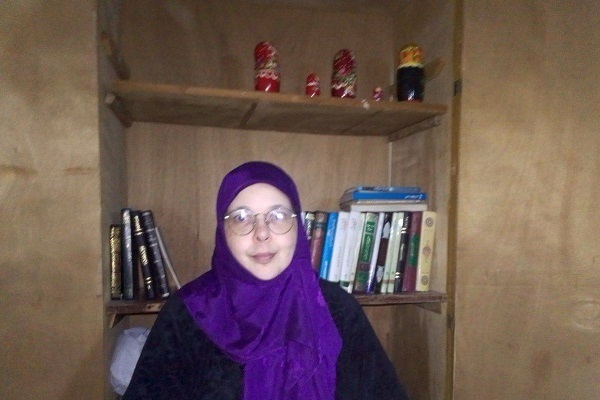
Author and media activist Hayat Lallab made the remarks in an interview with IQNA about the virtues, social role, and scriptural references linked to Lady Fatima (SA), who is revered by Muslims as Sayyidat Nisa al-Alamin — the Leader of the Women of the Worlds.
She said Lady Fatima (SA) was granted “unique qualities that no woman before her had been given” and that her elevated rank was tied to “the link between prophethood and guardianship,” as the daughter of the Holy Prophet (PBUH) and the mother of the Imams.
Lallab added: “She is the mother of her father and the mother of the Imams, and she supported the guardianship of Imam Ali (AS) while also guiding women and speaking the word of truth.”
Lallab noted that while Mary (SA) was the foremost woman of her era, Lady Fatima (SA) holds a rank “for all times.” She said the title Sayyidat Nisa al-Alamin appears not only in Shia texts but also in Sunni sources such as Sahih al-Bukhari, al-Bidaya wa’l-Nihaya, and Kanz al-Ummal.
Read More:
On Lady Fatima’s social role, Lallab said her responsibilities as a wife and mother never prevented her from public engagement. “Despite the difficult conditions faced by the Prophet’s household, she fulfilled her social duties,” she said.
Lallab described Lady Fatima (SA) as a pioneer in women’s education, saying she “established the first school for women and turned her blessed home into a place of learning.”
She also pointed to her involvement in charity, especially supporting the poor. “Her social role is a model that future generations must follow,” she said.
Lallab cited several Quranic verses to highlight Lady Fatima’s virtues, including the verse of purification in Surah al-Ahzab. She said: “This verse affirms that God purified the People of the Cloak completely,” referring to narrations that list the Prophet, Ali, Fatima, Hassan and Hussein (AS) among them.
She also referenced the verse of mubahala in Surah Al-Imran, as well as interpretations linking Lady Fatima (SA) to Surah al-Qadr and Surah al-Kawthar. She said, quoting a narration, that “God gave the Prophet the good news that his lineage would continue through Fatima.”
Lallab argued that Muslim women today need to reconnect with Lady Fatima’s example. “If a Muslim woman takes Fatima (SA) as her role model, modesty replaces shamelessness, and blind imitation of Western women fades,” she said.
Read More:
Discussing the Prophet’s statements about his daughter, she said: “The Prophet called her the spirit within him and said, ‘Whoever harms her has harmed me.’ He did so because he knew she would face great injustice after his death.”
She described teaching the life of Lady Fatima (SA) in universities as “a duty” that strengthens Islamic identity among students. Failing to do so, she warned, leaves youth vulnerable to cultural disconnection.
“We now see some Muslims ready to cooperate with the Zionist occupier,” she said, arguing that distancing from the Ahl al-Bayt’s teachings contributes to this situation.
Lallab said Lady Fatima’s example in marriage, parenting and ethics remains unmatched. “She taught us how a wife should treat her husband with respect and cooperation,” she said. Her children — Imam Hassan, Imam Hussein and Lady Zaynab (AS) — are, she argued, proof of her “school of moral and spiritual upbringing.”
4316272
